A Response to the Assertion That “There is No Text in the New Testament That Requires Gentile Believers to Observe the Biblical Feasts
All Rights Reserved.
“There is No Text in the New Testament
That Requires Gentile New Covenant Believers
To Observe the Biblical Feasts.”
Dedicated to the noble Bereans
that study whether those things be so.
Acts 17:10, 11.
| ©Copyright 2009, by Stephen W. Kraner. Limited royalty free copy/distribution release is herewith granted to the holder of this document for ten personal copies for the purpose of distribution to friends. On condition of royalty consideration of $0.75 per copy (after initial ten free copies), copy and distribution release is herewith granted of this document. Remit royalty consideration to: Stephen W. Kraner 821 S. Williams Street, Apt. C603 Westmont, IL 60559 USA E-mail: torah_guy@yahoo.com |
“There is No Text in the New Testament
That Requires
Gentile New Covenant Believers
To Observe the Biblical Feasts.”
By
Stephen W. Kraner
Outline.
- Introduction.
- Understanding Basics About the Covenants.
- What is the “Law” that was “Added Because of Transgression”? And, “When” was it Added?
- The Hebrew and Greek Words That are Translated as, “Feast.”
- Acts 17:25-27, 30.
- Acts 13:42-44, Gentiles Meet to Hear the Gospel on the Sabbath.
- Paul’s Admonition to the Greek Corinthians to “Continue Keeping the Feast [of Unleavened Bread].”
- The Philippians’ Keep the Feast of Unleavened Bread with the Apostle Paul.
- Paul’s Approval That the Church at Thessalonika Patterned Their Church After the Churches in Judea.
- Seeking YHWH at the Times Before Appointed, “My House, the Tabernacle of the Mo’edim, Shall be Called an House of Prayer for All Peoples.”
- Revelation 7:9-10: The Great Multitude and the Feast of Tabernacles.
- Summary.
- Appendix: The Sun and the Moon” Created to be Celestial Markers for the Timing of the Mo’edim.
Introduction.
One common argument against the New Covenant observance of the Biblical Feasts is that:
- “There are no texts in the New Testament that indicate that Gentile, New Covenant believers were required to observe the Biblical Feasts.”
The objective of this study is to refute this mis-perception.
In order to appreciate whether the Biblical Feasts belong to the original covenant and, hence, to the New Covenant, some basics about ancient covenants and the
Biblical covenants need first to be understood. Several aspects of both the Sinai covenant and the “New Covenant” shall be examined.
In order to appreciate “Why” the Biblical Feasts were to be observed by Gentile believers, two related questions must first be addressed: What is the “Law” that
was “added because of Transgression”? And, “When” was it added?
This mis-perception shall be addressed by showing what Hebrew words are translated as “feast” in the Hebrew Scriptures and, what their corresponding Greek
equivalent words are.
Next, it shall be shown that one of these Greek equivalent words for “feast” occurs in Acts 17:25-27, where the apostle Paul clearly speaks to unconverted
Greeks, adjuring them to repent of their worship of idols and to seek YHWH at the kairos before appointed, when all nations should seek YHWH.
The idea that the New Testament teaches that Gentiles observed YHWH’s Feasts shall be supported by examining Acts 13:42-44. There, we learn that nearly all
the Gentiles of the city of Antioch in Pisidia met together on YHWH’s Feast, the seventh-day Sabbath, to hear Paul teach the gospel.
Acts 17:25-27, 30, shall be additionally supported by Paul’s admonition to the Greek Corinthians to “continue keeping the feast [of unleavened bread].”
(1Corinthians 5:7-8)
Acts 17:25-27, 30, shall also be supported by Acts 20:6, where the Philippians join the apostle Paul in keeping the Feast of Unleavened Bread.
Acts 17:25-27, 30, shall also be supported by the apostle Paul’s approval of the Thessalonians’ patterning their church after the churches in Judea.
This text shall also be supported by Yahushua’s statement, “My house shall be called of all nations the house of prayer.” (Mark 11:17, quoting Isaiah 56:7, based
upon Solomon’s prayer in 1Kings 8:41-43.) And, that “house of prayer for all nations” is the “tabernacle of the mo’edim,” the “Tabernacle of the Feasts.”
And, Revelation 7:9-10 shall be examined to show that it describes a “great multitude” “of all nations” keeping the Feast of Tabernacles.
Understanding Basics About the Covenants.
In order to appreciate whether the Biblical Feasts belong to the original covenant and, hence, to the New Covenant, some basics about ancient covenants and the
Biblical covenants need first to be understood.
When an ancient covenant was “made” it was “cut.” In our King James Bibles, the words, “made a covenant” occur 28 times. The word, “made,” is translated
from the Hebrew word:
- Strong’s H3772, karath {kaw-rath’} a primitive root; to cut (off, down or asunder); by implication, to destroy or consume; specifically, to covenant (i.e. making an alliance or
bargain, originally by cutting flesh and passing between the pieces): – be chewed, be con-[feder-]ate, cut (down, off), destroy, fail, feller, be freed, hew (down), make a league
([covenant]), x lose, perish, x utterly, x want.
The Hebrew word, karath, occurs in 25 of the 28 occurrences of the phrase, “made a covenant.” Karath occurs 278 times in the Hebrew Scriptures. Karath
seems to be translated most frequently as “cut off” (181 times). It is translated as “cut down” 21 times. It is translated as “cut” only 8 times. Yet, “to cut’ is the
primary meaning of karath. Karath occurs for the first time, in relationship to “covenant” in Genesis 15:18:
- “9 And he said unto him, Take me an heifer of three years old, and a she goat of three years old, and a ram of three years old, and a turtledove, and a young pigeon.
- 10 And he took unto him all these, and divided them in the midst, and laid each piece one against another: but the birds divided he not.
- 17. And it came to pass, that, when the sun went down, and it was dark, behold a smoking furnace, and a burning lamp that passed between those pieces.
- 18 In the same day YHWH made [Strong’s H3772, karath] a covenant with Abram, saying, Unto thy seed have I given this land, from the river of Egypt unto the great river,
the river Euphrates:” Genesis 15:18.
In these words we see the full context of the ancient “cutting of a covenant.” Scholars understand that this cutting, into two, of animals, and then passing
in-between the divided halves existed in several ancient Mid-East cultures, especially the Hittite. Here is the “cutting of a covenant” where the animals are cut
into two or more pieces
- “18 And I will give the men that have transgressed my covenant, which have not performed the words of the covenant which they had made before me, when they cut [Strong’s
H3772, karath] the calf in twain, and passed between the parts thereof, - 19 The princes of Judah, and the princes of Jerusalem, the eunuchs, and the priests, and all the people of the land, which passed between the parts of the calf;
- 20 I will even give them into the hand of their enemies, and into the hand of them that seek their life: and their dead bodies shall be for meat unto the fowls of the heaven, and to
the beasts of the earth.” Jeremiah 34:18-19.
The words, “their dead bodies shall be for meat unto the fowls of the heaven, and to the beasts of the earth,”find their fulfillment and their enforcement in
Revelation 19:17-21.
When the Ten Commandments were made, they were “cut” with the finger of Elohim into the stone tablets.
- “9 When I was gone up into the mount to receive the tables of stone, [even] the tables of the covenant which YHWH made [Strong’s H3772, karath] with you, then I abode in
the mount forty days and forty nights, I neither did eat bread nor drink water: - 10 And YHWH delivered unto me two tables of stone written with the finger of Elohim; and on them [was written] according to all the words, which YHWH spake with you in the
mount out of the midst of the fire in the day of the assembly.” Deuteronomy 9:9-10.
It is important to note that the “Ten Commandments” are actually, in Hebrew, the “Ten Words,” hence, the word, Decalogue, a middle English word derived
from Old Latin meaning, Ten Words.
- “28. And he was there with YHWH forty days and forty nights; he did neither eat bread, nor drink water. And He wrote upon the tables the words [Strong’s H1697, debar] of the
covenant, the ten commandments [Strong’s H1697, debar].” Exodus 34:28. - “13 And He declared unto you His covenant, which He commanded you to perform, [even] Ten Commandments [Strong’s H1697, debar]; and He wrote them upon two tables of
stone.” Deuteronomy 4:13. - “4 And He wrote on the tables, according to the first writing, the ten commandments [Strong’s H1697, debar], which YHWH spake unto you in the mount out of the midst of the
fire in the day of the assembly: and YHWH gave them unto me.” Deuteronomy 10:4.
- Debar: Strong’s H1697, a word; by implication, a matter (as spoken of) or thing; adverbially, a cause. Plural = “debarim.”
This distinction of the Ten Commandments being the Ten Words of YHWH, the Ten Debarim, is a most important distinction. By not noting this distinction, the
King James translators caused a misunderstanding of the relationship of the Ten Debarim to the various types of laws contained in the Covenant of YHWH with
Israel. Specifically, the King James translators translated both words, “mitsvot” and, “debarim” as “commandments.” As noted above, the Hebrew word,
“debar,” is a word as of (or “about”) a spoken matter. That is, though “debar” can mean a single “word,” the word, “debar” can also mean, “a
summary word about a whole matter or, discussed subject.” For example:
- “26 Wherefore they called these days Purim after the name of Pur. Therefore for all the words [debar] of this letter, and [of that] which they had seen concerning this matter
[debar], and which had come unto them,” Esther 9:26.
To further appreciate that the Ten Debarim (Ten Commandments) are Ten Summary Words for the various laws of the Covenant, please note the full context of
Exodus 34:28 (the first mention of the words, “Ten Commandments” in Scripture). (Those readers that are scholars take note: The Biblical hermeneutic, “the
rule of first mention,” in relationship to its context, has significant bearing here.)
- “10. And he said, BEHOLD, I MAKE A COVENANT: before all thy people I will do marvels, such as have not been done in all the earth, nor in any nation: and all the people
among which thou [art] shall see the work of YHWH: for it [is] a terrible thing that I will do with thee. - 11 Observe thou that which I command thee this day: behold, I drive out before thee the Amorite, and the Canaanite, and the Hittite, and the Perizzite, and the Hivite, and the
Jebusite. - 12 Take heed to thyself, lest thou make a covenant with the inhabitants of the land whither thou goest, lest it be for a snare in the midst of thee:
- 13 But ye shall destroy their altars, break their images, and cut down their groves:
- 14 For thou shalt worship no other g-d: for YHWH, whose name [is] Jealous, [is] a jealous G-d:
- 15 Lest thou make a covenant with the inhabitants of the land, and they go a whoring after their g-ds, and do sacrifice unto their g-ds, and [one] call thee, and thou eat of his
sacrifice; - 16 And thou take of their daughters unto thy sons, and their daughters go a whoring after their g-ds, and make thy sons go a whoring after their g-ds.
- 17 Thou shalt make thee no molten g-ds.
- 18. The Feast of Unleavened Bread shalt thou keep. Seven days thou shalt eat unleavened bread, as I commanded thee, in the time of the month Abib: for in the month Abib thou
camest out from Egypt. - 19 All that openeth the matrix [is] mine; and every firstling among thy cattle, [whether] ox or sheep, [that is male].
- 20 But the firstling of an ass thou shalt redeem with a lamb: and if thou redeem [him] not, then shalt thou break his neck. All the firstborn of thy sons thou shalt redeem. And none
shall appear before Me empty. - 21 Six days thou shalt work, but on the seventh day thou shalt rest: in earing time and in harvest thou shalt rest.
- 22 And thou shalt observe the Feast of Weeks, of the firstfruits of wheat harvest, and the Feast of Ingathering at the year’s end.
- 23 Thrice in the year shall all your menchildren appear before Adown YHWH, the Elohim of Israel.
- 24 For I will cast out the nations before thee, and enlarge thy borders: neither shall any man desire thy land, when thou shalt go up to appear before YHWH thy Elohim thrice in the
year. - 25 Thou shalt not offer the blood of My sacrifice with leaven; neither shall the sacrifice of the Feast of the Passover be left unto the morning.
- 26 The first of the firstfruits of thy land thou shalt bring unto the house of YHWH thy Elohim. Thou shalt not seethe a kid in his mother’s milk.
- 27 And YHWH said unto Moses, Write thou these words: FOR AFTER THE TENOR OF THESE WORDS [Strong’s H1697, debar] I HAVE MADE A COVENANT
with thee and with Israel. - 28. And he was there with YHWH forty days and forty nights; he did neither eat bread, nor drink water. AND HE WROTE UPON THE TABLES THE WORDS [Strong’s
H1697, debar] OF THE COVENANT, THE TEN COMMANDMENTS [Strong’s H1697, debar].” Exodus 34:10-28.
I call your attention, again, to the understanding that the Hebrew word, “debar,” has the idea of being a “summary word” of a spoken matter.
- Debar: Strong’s H1697, a word; by implication, a matter (as spoken of) or thing; adverbially, a cause. Plural = “debarim.”
In Exodus 34:10-28, after reviewing the highlights of the (covenant described in Exodus chapters 20 through 23, with the confirmation of the covenant in
Exodus 24:1-8), YHWH states, “FOR AFTER THE TENOR OF THESE WORDS [Strong’s H1697, debar] I HAVE MADE A COVENANT with thee
and with Israel.” (Exodus 34:27) Then, in verse 28, YHWH writes upon the tables of stone “THE WORDS OF THE COVENANT”!!! But, they are not all
the words contained in Exodus chapters 20 through 23. Nor are they all the words in Exodus 34:10-26. The “Ten Words” of the Covenant stand as
summary words for the rest of the words of the covenant!
Within the details of the covenant recorded in Exodus, chapters 21-23, in Exodus 23:10-17, the seventh-day Sabbath and the three annul pilgrim Feasts are
included PRIOR TO Israel’s worship of the golden calf. When YHWH renews His covenant with Israel after their worship of the golden calf, did you notice that
the Feasts are again listed in verses 18, 21-23, as continuing to belong to the renewed Sinai Covenant? Remember this point, when we examine WHY a “law”
was “added because of transgression.”
| The “Ten Words” of the Covenant
Stand as Summary Words for the rest of the words of the Covenant! |
It is claimed by some that the Covenant contained in the Tables of Stone and the Covenant contained in the scroll of the law are two different covenants. Here is
shown the ignorance of both the Scriptures and of ancient covenants. Anciently, the summary words of a covenant between a suzerain lord and either, a vassal
lord or, his own vassals, were “cut” into wood, stone or, metal or, occasionally, in plaster, while the details of the same covenant were written in a book.
We see this combination of the SAME words written on a tablet and in a book in Isaiah 30:8:
- “8. Now go, write IT before them in a table [Strong’s H3871, luwach], and note IT in a book [Strong’s H5612, cepher], that it may be for the time to come for ever and ever:” Isaiah
30:8. - Strong’s H3871, luwach {loo’-akh} or luach; from a primitive root; probably meaning to glisten; a tablet (as polished) of stone, wood, or metal: -board, plate, table.
- Strong’s H 5612, cepher {say’-fer} or (feminine) ciphrah; from H5608; properly, writing (the art or a document); by implication, a book: -bill, book, evidence, x learn[-ed] (-ing), letter,
register, scroll.
YHWH makes a prophecy, which, by virtue of the combined imagery of the “tablet” and the “book,” He makes to be an eternal covenant. The significant point is
that the SAME prophecy is written BOTH on the table and in the book. From the witness of Isaiah 30:8, we are informed of the parallel of SAME words in the
Tables of the Covenant to the Book of the Covenant.
Comprehending the parallel of the words of the “covenant prophecy” referred to above in Isaiah 30:8 (that what was written upon the tablet was also written in
the book), in the Torah, we have references to “the Tables of the Covenant” and references to “the Book of the Covenant.”
The Tables of the Covenant.
- “27 And YHWH said unto Moses, Write thou these words: for after the tenor of these words [Strong’s H1697, debar] I have made a covenant with thee and with Israel.
- 28. And he was there with YHWH forty days and forty nights; he did neither eat bread, nor drink water. And he wrote upon the TABLES [Strong’s H3871, luwach] the Words [Strong’s
H1697, debar] of the Covenant, the Ten Commandments [Strong’s H1697, debar].” Exodus 34:28. - “11 And it came to pass at the end of forty days and forty nights, [that] YHWH gave me the two tables [Strong’s H3871, ;uwach] of stone, [even] the Tables [Strong’s H3871, luwach] of
the Covenant.” Deuteronomy 9:11.
The Book of the Covenant.
- “7 And he took the Book [Strong’s H5612, cepher] of the Covenant, and read in the audience of the people: and they said, All that YHWH hath said will we do, and be obedient.” Exodus
24:7. - “2 And the king went up into the house of YHWH, and all the men of Judah and all the inhabitants of Jerusalem with him, and the priests, and the prophets, and all the people, both small
and great: and he read in their ears all the words [Strong’s H1697, debar] of the Book [Strong’s H5612, cepher] of the Covenant which was found in the house of YHWH.” 2Kings 23:2.
Isaiah 30:8 Clearly Reveals the Ancient Covenant Custom That, What was Written Upon the Table(s) of the Covenant, Was also Written in the Book of the Covenant. “8. Now go, write IT before them in a TABLE [Strong’s H3871, luwach], and note IT in a BOOK [Strong’s H5612, cepher], that it may be for the time to come for ever and ever:” Isaiah 30:8. |
So, we see that the “Words of the Covenant,” (whether written in “summary” (on stone) or, written in “detail” (in the book)), are written BOTH upon the Tables
of the Covenant AND in the Book of the Covenant!
In Nehemiah 9:13-14, we have a text that supports the idea that the spoken words of the covenant are the SAME (at least as “summary words”) as the, written
by the hand of Moses, book of the covenant.
Nehemiah 9:13-14 explains that the SAME DIVISIONS of the Ten Commandments that were spoken by YHWH from Sinai were also given by the hand of
Moses. In Nehemiah 9:13-14, we have a reference to a paralleling of the Ten Words that were spoken by YHWH on Mount Sinai to the laws that were written
by Moses.
- “13 Thou camest down also upon mount Sinai, and spakest with them from heaven, and gavest them right judgments [Strong’s H4941, mishpatim], and true laws [Strong’s H8451,
torah], good statutes [Strong’s H2706, choqqim] and commandments [Strong’s Hmitsvot]: - 14 And madest known unto them thy holy Sabbath, and commandedst them precepts [Strong’s H4687 mitsvot], statutes [Strong’s H2706, choqqim], and laws [Strong’s H8451,
torah], by the hand of Moses thy servant:” Nehemiah 9:13, 14.
The understanding is that the words, “right judgments, and true laws, good statutes and commandments,” are associated with the words: “and spake with them,”
in verse 13; and then, “precepts, statutes, and laws” are associated with the words: “madest known…and commandedst…by the hand of Moses.” Notice the
correspondence between what was spoke and what was written by the hand of Moses. Again, here we have a parallel between what was written upon the
tables of stone (what was spoken by YHWH) and what was written in the book (what was written by the hand of Moses).
Thou Spakest:
| Thou Gavest By The Hand of Moses:
|
In verse 13, we have this list of four words:
- Right judgments = Strong’s H3477 yashar (right) H4941 mishpat (verdict/judgment);
- True laws = Strong’s H571 >emeth (true/trustworthy/faithful) Strong’s H8451 torah (a precept or statute);
- Good Statutes = Strong’s H2896 towb {tobe} (good) Strong’s H2706 chok {khoke} (statutes, an enactment/decree, an appointment (of time, space,
quantity, labor or usage)); and, - Commandments = Strong’s H4687 mitsvah (a command, law ordinance, precept).
These four words relate to that which was “spoken” from mount Sinai.
In verse 14, we have this list:
- Precepts = Strong’s H4687 mitsvah (a command, law ordinance, precept).
- Statutes = Strong’s H2706 chok {khoke} or, chuq {khook} (statutes, an enactment/decree, an appointment (of time, space, quantity, labor or usage)); and,
- Laws = Strong’s H8451 torah (a precept or statute).
These three words relate to that which was “made known…by the hand of Moses.”
The main three divisions of the Law as understood by the Jews, in their plural form, are:
- Commandments = mitsvot
- Statutes = chokim or, chuqqim
- Judgments = mishpatim
These three divisions of the Law are supported by the following texts:
- “31 But as for thee, stand thou here by me, and I will speak unto thee all the commandments [Strong’s H4687, mitsvot], and the statutes [Strong’s H2706, chuqqim], and the
judgments [Strong’s H4941, mishpatim], which thou shalt teach them, that they may do [them] in the land which I give them to possess it.” Deuteronomy 5:31.
- “1. Now these [are] the commandments [Strong’s H4687, mitsvot], the statutes [Strong’s H2706, chuqqim], and the judgments [Strong’s H4941, mishpatim], which YHWH your
Elohim commanded to teach you, that ye might do [them] in the land whither ye go to possess it:” Deuteronomy 6:1. - “11 Thou shalt therefore keep the commandments [Strong’s H4687, mitsvot], and the statutes [Strong’s H2706, chuqqim], and the judgments [Strong’s H4941, mishpatim], which I
command thee this day, to do them. - 12. Wherefore it shall come to pass, if ye hearken to these judgments, and keep, and do them, that YHWH thy Elohim shall keep unto thee the covenant and the mercy which He sware
unto thy fathers:” Deuteronomy 7:11-12. - “1. Therefore thou shalt love YHWH thy Elohim, and keep His charge, and His statutes [Strong’s H2706, chuqqim], and His judgments [Strong’s H4941, mishpatim], and His
commandments [Strong’s H4687, mitsvot], alway.” Deuteronomy 11:1.
Comparing Nehemiah 9 verse 13 to verse 14, the Ten Words, being divided into the three or four types of commands, consist as an index, or topic headings, for
the rest of the Law spoken by God to Moses and written by Moses upon scroll(s).
According to Nehemiah 9:13-14, the SAME divisions of the Words of the Covenant (mitsvot, chuqqim and, mishpatim; commandments, statutes and,
judgments) which were spoken by YHWH on Mount Sinai and written with His own finger upon tables of stone and called, “the Tables of the Covenant”; and,
the SAME divisions of the Words of the Covenant were also given in detail to Moses to write in a book which was called “the Book of the Covenant.” The
Tables of the Covenant were placed inside of the Ark of the Covenant. And, the Book of the Covenant was placed in the side of the Ark of the Covenant. BOTH
were placed in the Most Holy Place of the Mosaic Tabernacle.
The Jewish understanding of the manner in which the Ten Commandments are divided into these three types of commands are:
First, that the Ten Commandments are divided by the first five commandments that have the Sacred Name, YHWH, (commonly understood to be pronounced:
Yahweh; but, understood by this author to be pronounced: Yahuwah); and, the second five that do not have the Sacred Name. While Adventism divides the Ten
Commandments into the first four as pertaining to Elohim and the last six as pertaining to man, the Jewish understanding is that the Sacred Name in the first five
commandments reveals that they pertain to man’s duty to Elohim. This includes the Fifth Commandment that requires that we honor our Father and Mother. This
is so because Elohim have ordained that the father and mother stand in the place of G-d to their children.
- “The family institution is a divine ordinance. Parents stand in the place of God to their children.” Ellen G. White, The Signs of the Times, May 7, 1894.
The last five commandments pertain to man’s duty to man. This division is supported in the New Testament by Paul’s statement in Romans 13:9:
- “9 For this, Thou shalt not commit adultery, Thou shalt not kill, Thou shalt not steal, Thou shalt not bear false witness, Thou shalt not covet; and if [there be] any other
commandment, it is briefly comprehended in this saying, namely, Thou shalt love thy neighbour as thyself.”
Please note that Paul does not include the Fifth Commandment. He teaches that it is the last five commandments that are comprehended by the words, “Thou
shalt love thy neighbor as thyself.”
The First and Second Commandments are understood by the Jews to be Mitsvot, (commandments). The Third, Fourth and Fifth Commandments are understood
by the Jews to be Chokim, (statutes). The last five commandments are understood to be “Mishpatim,” (judgments). Thus, we have the Ten Commandments
divided in this manner:
The Ten Commandments (With Their Divisions of Mitsvot, Chuqqim, and Mishpatim) |
Our Duty To Elohim. “5 And thou shalt love YHWH thy Elohim with all thine heart, and with | Our Duty To Our Fellow Man. “18 …thou shalt love thy neighbour as thyself: I [am] YHWH.” |
|
Commandment First. “2 I [am] YHWH thy Elohim, which have | Division of the Law. Mitsvah – Commandment |
Commandment Sixth. “13 Thou shalt not kill. | Division of the Law. Mishpat – Judgment |
Second. 4 Thou shalt not make unto thee any graven |
Mitsvah – Commandment | Seventh. 14 Thou shalt not commit adultery. |
Mishpat – Judgment |
Third. 7 Thou shalt not take the name of YHWH thy |
Chok – Statute | Eighth. 15 Thou shalt not steal. |
Mishpat – Judgment |
Fourth. 8 Remember the Sabbath day, to keep it holy. 9 Six |
Chok – Statute | Ninth. 16 Thou shalt not bear false witness against thy |
Mishpat – Judgment |
Fifth. 12. Honour thy Father and thy Mother: that thy |
Chok – Statute | Tenth. 17 Thou shalt not covet thy neighbour’s house, |
Mishpat – Judgment |
The Biblical Feasts are defined, in Scripture, as “statutes” and, “judgments”:
Feast of Unleavened Bread, Pentecost, and Feast of Tabernacles.
- “1 Now these are the judgments [Strong’s H4941, mishparim] which thou shalt set before them:…”
- “14 Three times thou shalt keep a feast unto Me in the year.
- “15 Thou shalt keep the feast of unleavened bread: (thou shalt eat unleavened seven days, as I commanded thee, in the time appointed of the month of Abib; for in it thou camest out from
Egypt: and none shall appear before Me empty:) - 16 And the feast of harvest [Pentecost], the first fruits of thy labors, which thou hast sown in the field: and the feast of ingathering [Feast of Tabernacles], which is in the end of the
year, when thou hast gathered in thy labors out of the field. - “17 Three times in the year all thy males shall appear before YHWH Elohim.” Exodus 21:1; 23:14-17.
- All the Biblical Feasts are here listed as Judgments – Mishpatim.
Pentecost.*
- “21 And ye shall proclaim on the selfsame day, that it may be an holy convocation unto you: ye shall do no servile work therein: it shall be a statute [Strong’s H2708, chuqqah] for ever in
all your dwellings throughout your generations.” Leviticus 23:21. Pentecost is listed as a Statute – Chuqqim.
Day of Atonement.(1)
- “31 Ye shall do no manner of work: it shall be a statute [Strong’s H2708, chuqqah] for ever throughout your generations in all your dwellings.” Leviticus 23:31. The Day of
Atonement is listed as a Statute – Chuqqim.
Feast of Tabernacles.
- “39 Also in the fifteenth day of the seventh month, when you have gathered in the fruit of the land, ye shall keep a feast unto YHWH seven days:… 41 And ye shall keep it a feast
unto YHWH seven days in the year. It shall be a statute [Strong’s H2708, chuqqah] for ever in your generations: ye shall celebrate it in the seventh month.” Leviticus 23:39, 41.
The Feast of Tabernacles is listed as a Statute – Chuqqim.
When we turn to the writings of the New Covenant believers, we find a confirming parallel to the idea that what was written in stone must be included with the
words that were written with ink, the Torah.
2Corinthians 3:3-11.
- “3 [Forasmuch as ye are] manifestly declared to be the epistle of Christ ministered by us, WRITTEN NOT WITH INK [The Torah/Mosaic Law], but with the Spirit of the living
God; NOT IN TABLES OF STONE [The Ten Commandments], but in fleshy tables of the heart. - 4 And such trust have we through Christ to G-d-ward:
- 5 Not that we are sufficient of ourselves to think any thing as of ourselves; but our sufficiency [is] of G-d;
- 6. Who also hath made us able ministers of the new testament [New Covenant]; not of the letter, but of the Spirit: for the letter killeth, but the Spirit giveth life.
- 7 But if the ministration of death, written [and] engraven in stones, was glorious, so that the children of Israel could not stedfastly behold the face of Moses for the glory of his
countenance; which [] [ministration (of death)] was to be done away: - 8 How shall not the ministration of the Spirit be rather glorious?
- 9 For if the ministration of condemnation [be] glory, much more doth the ministration of righteousness exceed in glory.
- 10 For even that which was made glorious had no glory in this respect, by reason of the glory that excelleth.
- 11 For if that which is done away [was] glorious, much more that which remaineth [is] glorious.”
It must be perfectly clear: The Ten Commandments, when engraved into the tables of stone, were not written with “ink”!!! Neither are the living epistles of the
Corinthian believers written with “Ink.” IT WAS THE TORAH WHICH WAS WRITTEN WITH “INK.” 2Corinthians 3:3 teaches that what was previously
written with ink (the Torah) AND that which was written in tables of stone (the Ten Commandments) is now written by the Spirit of the living G-d in “fleshly
tables of the heart.”
In light of this, when verse 3 says:
- “3 [Forasmuch as ye are] manifestly declared to be the epistle of Messiah ministered by us, written not with ink, but with the Spirit of the living G-d; not in tables of stone, but in
fleshy tables of the heart.“
Paul is saying that the Corinthian believers are a living epistle of the Messiah. Notice the similarity in the phrases:
“…not with ink…”
“…not in tables of stone…”
Paul alludes to the Torah (which was written with ink) and to the Ten Commandments (which were engraved in tables of stone). The Ten Commandments were
written with the “finger of G-d.” (Exodus 31:18; Deuteronomy 9:10.) But, under the New Covenant, the Holy Spirit writes both the Ten Commandments and the
Torah upon our hearts.
Through two references to the Hebrew Scriptures, the Book of Hebrews informs us of the Hebrew Scripture basis for the New Covenant:
New Testament Regarding the “New Covenant.” Hebrews 8:7-13. “7 For if that first [covenant] had been faultless, then should no place have been sought for the 8 For finding fault with them, he saith, Behold, the days come, saith YHWH, when I will make a NEW 9 Not according to the covenant that I made with their fathers in the day when I took them by the 10 For this [is] the COVENANT that I will make with the house of Israel after those days, saith 11 And they shall not teach every man his neighbour, and every man his 12 For I will be merciful to their unrighteousness, and their sins and their 13 In that he saith, A new [covenant], he hath made the first old. Now that | The Old Testament Regarding the “New Covenant.” Jeremiah 31:31-35. “31 Behold, the days come, saith YHWH, that I will make a NEW COVENANT with the house of 32 Not according to the covenant that I made with their fathers in the day [that] I took them by the 33 But this [shall be] the COVENANT that I will make with the house of Israel; After those days, 34 And they shall teach no more every man his neighbour, and every man his |
Hebrews 10:22. “22 Let us draw near with a true heart in full assurance of faith, having our HEARTS SPRINKLED | Ezekiel 36:25-27. “25. Then will I SPRINKLE CLEAN WATER upon you, and ye shall be clean: from all your filthiness, |
The “New Covenant” is defined by the New Testament as having its basis drawn from Jeremiah 31:31-34 and Ezekiel 36:26, 27. Thus, the Old Testament
definition of the “New Covenant” is that YHWH will place His Spirit within us, (thus, giving us New Hearts); He will write His Torah upon our hearts, and
cause us to walk in the statutes and judgments of the Mosaic Law. Anyone teaching a Gospel of the New Covenant that is not in harmony with the Biblical
definition that the New Covenant is the promise to cause us to obey the STATUTES and JUDGMENTS of the TORAH through the power and ministry of the
Spirit of YHWH is teaching a false Gospel.
The same Torah, the same words of the Covenant, that was the terms of the first covenant are also the terms of the New Covenant. The difference is that Israel
covenanted to obey the terms of the covenant from a fallen human nature. But, under the New Covenant, YHWH covenants to perform to works of the Torah in
our new hearts (new nature) by the power and ministry of His Spirit.
What is the “Law” that was “Added Because of Transgression”?
And, “When” was it added?
| “22 For I spake not unto your fathers, nor commanded them in the day that I brought them out of the land of Egypt, concerning burnt offerings or sacrifices:” Jeremiah 7:22. |
Because it is the general perception of the theology of common Christianity that the Biblical Feasts belong to “the law that was added because of transgression”
(commonly called, the Ceremonial Law) it must first be established what “Law” was added because of transgression and “when” was it added. The idea that there
was a “law” that was added because of transgression is taken from Galatians 3:19:
- “18 For if the inheritance [be] of the law, [it is] no more of promise: but God gave [it] to Abraham by promise.
- 19. Wherefore then [serveth] the law? It was added because of transgressions, till the seed should come to whom the promise was made; [and it was] ordained by angels in the
hand of a mediator.” Galatians 3:18, 19.
Daniel Botkin, in an article titled, Until the Seed Should Come, in his periodic newsletter, The Gates of Eden, Nov.-Dec. 2001, pages 11-12, states:
- “‘The law was added because of transgressions’ This statement alone strongly implies (if not proves) that there was, indeed, an already-existing Torah, because ‘where no law is,
there is no transgression’ (Romans 4:15). In order for transgression to exist, there must be a law to transgress. It was the transgression of the already-existing Torah that made it
necessary to add the law of burnt-offerings and sacrifices. Therefore, we could understand Galatians 3:19 to mean ‘the law [of burnt-offerings and sacrifices] was added because
of transgressions [against Torah]'” Daniel Botkin, Until the Seed Should Come, Gates of Eden, Nov.-Dec. 2001, pages 11-12.
In the Garden of Eden, after eating of the Tree of the Knowledge of Good and Evil, Adam an Eve, realizing that they were “naked,” made garments of fig leaves.
- “6. And when the woman saw that the tree [was] good for food, and that it [was] pleasant to the eyes, and a tree to be desired to make [one] wise, she took of the fruit thereof, and
did eat, and gave also unto her husband with her; and he did eat. - 7 And the eyes of them both were opened, and they knew that they [were] NAKED; and they sewed fig leaves together, and made themselves aprons.” Genesis 3:6-7.
Jewish tradition states that the Tree of the Knowledge of Good and Evil was a fig tree. Realizing their nakedness, Adam and Eve made the leaves of the Tree of
the Knowledge of Good and Evil to be their “covering.” But, in Genesis 3:21, Elohim provides “skins” to be the “covering” for Adam and Eve.
- “21. Unto Adam also and to his wife did YHWH Elohim make coats of skins, and clothed them.” Genesis 3:21.
That “skins” were used informs us that YHWH Elohim taught Adam and Eve that leaves from a tree (especially, leaves from the very tree of disobedience) were
insufficient to cover their nakedness. YHWH taught Adam and Eve (through the animal “skins”) that “death” was required in order to cover their nakedness.
These “skins” were the skins of the first animal sacrifices. HERE WAS THE BEGINNING OF THE “LAW ADDED BECAUSE OF TRANSGRESSION.”
With the Passover and Israel’s “exodus” from Egypt, Israel, the nation, was born in a day. At Mount Sinai, (which is also the DATE of Pentecost), YHWH spoke
His Ten Words (Ten Commandments). Israel complained to Moses saying that when YHWH spoke, it scared them to death. Israel begged of Moses to learn all
the details of YHWH their Elohim’s will. YHWH agreed that Moses should hear all the words of instruction from YHWH to Israel and then communicate them
to Israel. These additional laws were but the elaboration of the Ten Words. Also, it must be clearly understood that Israel has not yet worshiped the golden calf.
It was near the end of the forty days, while Moses was upon Mount Sinai, that Aaron made the golden calf and Israel worshiped it.
At Sinai, after having received the proclamation of the Law, and while Moses was obtaining the details of the covenant and, after having broken that law by
worshiping the golden calf, Israel was described as being “naked”:
- “21. And Moses said unto Aaron, What did this people unto thee, that thou hast brought so great a sin upon them?
- 25 And when Moses saw that the people [were] NAKED; (for Aaron had made them NAKED unto [their] shame among their enemies:)” Exodus 32:21, 25.
Then Moses said to the people:
- “30. And it came to pass on the morrow, that Moses said unto the people, Ye have sinned a great sin: and now I will go up unto YHWH; peradventure I shall make an atonement
[Strong’s H03722, kippur, to cover] for your sin.” Exodus 32:30.
Israel had become “naked,” losing the “covering” that the Sinai covenant was to have afforded by worshiping the golden calf. Moses sought to gain, again, a
“covering” for Israel’s nakedness.
| When we compare the “nakedness” that occurred after Adam and Eve ate of the Tree of the Knowledge of Good and Evil to the “nakedness” that resulted from Israel’s worship of the golden calf AFTER the initial covenant was made at Sinai, but PRIOR TO the “law that was added because of transgression (the worship of the golden calf, WE ARE FORCED TO ACKNOWLEDGE THAT YHWH’s FEASTS EXISTED FIRST IN THE INITIAL COVENANT (Exodus 23:14-17; and, Exodus 34:18, 21-23) PRIOR TO THE ADDITION OF THE LAW THAT WAS ADDED BECAUSE OF TRANSGRESSION FOR THE PURPOSE OF “COVERING” ISRAEL’s NAKEDNESS. |
Here, I quote from the writings of Ellen G. White, because she succinctly writes an astounding observation regarding the “timing” of the giving of the law of
sacrifices:
- “…AFTER THE COMPLETION OF THE TABERNACLE He communicated with Moses from the cloud of glory above the mercy seat, and gave him full directions concerning
the system of offerings and the forms of worship to be maintained in the sanctuary. The ceremonial law was thus given to Moses, and by him written in a book…” - “There are many who try to blend these two systems, using the texts that speak of the ceremonial law to prove that the moral law has been abolished; but this is a perversion of
the Scriptures. The distinction between the two systems is broad and clear.” Ellen G. White, Patriarchs and Prophets, page 365.
Letting the lesser light (the Spirit through the pen of Ellen White) lead us to the greater light of Scripture, an examination of the Holy Scriptures, in light of the
above quotation, will aid in understanding the demarcation between the statutes and judgments and the ceremonial law. Get out your Bible and look at Exodus
20. There you have the Ten Commandments. Now go to chapter 21. Here begin some of the very “judgments,” or “statutes” which explain more fully each of the
Ten Words. They are the details of the meaning of the Ten Commandments. These “judgments continue all the way through the end of chapter 23. The three
annual feasts, the Feast of Unleavened Bread, Pentecost, and the Feast of Tabernacles, are listed among the “judgments” in Exodus 23:14-17. In chapter 24,
Moses tells “the people all the words of YHWH, and all the judgments.” See verse 3. The next morning, the Old Covenant is ratified with Israel, the nation.
Please note the similarity, yet difference, between the Old and New covenants. In Exodus 24:8, Moses sprinkles the blood “on the people, and said, Behold the
blood of the covenant…” In Matthew 26:27, 28, Yahushua takes the cup, “and gave thanks, and gave it to them, saying, Drink ye all of it; for this is My blood of
the New Testament (New Covenant), which is shed for many for the remission of sins.”
As was noted previously, Jeremiah 31:31-34 and Ezekiel 36:26, 27 prophesy of the New Covenant:
- “31 Behold, the days come, saith the Lord, that I will make a NEW COVENANT with the house of Israel, and with the house of Judah…this shall be the covenant which I shall make with the house
of Israel; After those days, saith YHWH, I will put My LAW [Strong’s H8451, torah] in their inward parts, and write it in their hearts; and will be their Elohim, and they shall be My people.”
Jeremiah 31:31-34. - “26 A new heart also will I give you, and a new spirit will I put within you:…and I will give you an heart of flesh. And I will put My Spirit within you, and cause you to walk in My STATUTES, and
you will keep My JUDGMENTS, and do them….and ye shall be My people, and I will be your Elohim.” Ezekiel 36:26, 27.
The New Covenant, therefore, contains the SAME statutes and judgments which the Old Covenant contained, but now instead of being ratified with the blood of
a lamb, the New Covenant is ratified with the blood of the only begotten Son of YHWH Elyown, Yahushua ha’Messhiach!
With His sermon on the mount, with His parables, with His teachings, and with His holy example, Yahushua, another prophet like unto Moses (see Deuteronomy
18:15 and Acts 7:37, 38), had told all the “words of the covenant and the “judgments” of the covenant afresh,(2) and now was ratifying the covenant with His
own blood, instead of the blood of a slaughtered animal substitute, shown in the emblem of the cup of grape juice. In the Old Covenant, the blood of the
Covenant was sprinkled upon the believers; in the New Covenant, the blood of the Covenant, in symbol, was drank by the believer. These examples help us to
understand the parallel of the Old Covenant to the New. The parallel of the events of the Exodus of literal Israel to the life, teachings, and death of Yahushua,
must be understood in order to appreciate what the New Covenant is actually covenanting!
Back to Exodus. Following “the blood of the covenant” ceremony, Moses, prefiguring Messiah and His ascension to heaven, ascends up into “the mountain of
Elohim,” mount Sinai. There, He receives, beginning in chapter 25, the specifications for the construction of the tabernacle. This “building of a
temple/tabernacle” motif is paralleled in Acts 4:11: “This is the stone which was set at nought of you builders…” Like Moses, following the ratification of the
Covenant, Yahushua ascended up into the mountain of Elohim, the third heaven. In relation to that ascension, the church, a living temple is being built.
(Ephesians 2:20-22; 1Peter 2:5) There is much truth to be discovered in the comparisons between the ministry of Moses, and the ministry of Yahushua.
The description of the tabernacle with the vestments of the priests and High Priest continue through the end of Exodus, chapter 28. Remember, Ellen White
stated:
- “[A]FTER the completion of the tabernacle, He [G-d] communicated with Moses…directions concerning the system of offerings….The ceremonial law was thus given to Moses…”
It is in chapter 29, that the description of the Ceremonial Laws begin! The only possible reference to a sacrificial law previous to Exodus 29 is in Exodus 23:18.
- “18 Thou shalt not offer the blood of My sacrifice with leavened bread; neither shall the fat of My sacrifice remain until the morning.”
But, the phrase, “My sacrifice” refers to the offering of Yahushua ha’Messhiach, rather than to animal sacrifices. Furthermore, this law seems to continue after
the cross in that unleavened bread continues to be used in the Communion service which “shows the Lord’s death.” (1Corinthians 11:26) THIS MEANS THAT
THE LAWS PRIOR TO EXODUS 29 ARE NOT CEREMONIAL!! Now look back to Exodus 23:10, 11. Here the sabbatical year law is given. Next, is
mentioned the seventh-day Sabbath, followed by, a verse later, the phrase, “Three times thou shalt keep a feast unto me in the year.” These three feasts unto
YHWH are: Passover, Pentecost, and the Feast of Tabernacles.
The above evidence shows that those “judgments” specifying the observance of the feasts are located among the laws which Moses received as amplifying the
principles of the Ten Commandments. They are the details of the Covenant. They are not located in the section of laws where the laws of sacrifices begin.
In Jeremiah 7:21-23 we find an emphatic statement by YHWH that in His initial covenant, He did not include sacrifices and offerings.
- “21. Thus saith YHWH of hosts, the Elohim of Israel; Put your burnt offerings unto your sacrifices, and eat flesh.
- 22 For I spake not unto your fathers, nor commanded them in the day that I brought them out of the land of Egypt, concerning burnt offerings or sacrifices:
- 23 But this thing commanded I them, saying, Obey My Voice, and I will be your Elohim, and ye shall be My people: and walk ye in all the ways that I have commanded you, that it may be well
unto you.” Jeremiah 7:21-23.
After Moses intercession, AGAIN, A LAW WAS ADDED (after the Sinai covenant), in order to COVER Israel’s “nakedness,” brought upon BECAUSE OF
(Israel’s) TRANSGRESSION (of the worship of the golden calf). That law was the whole sacrificial system. It was added AFTER even the details of the
Tabernacle were provided to Moses. Which means that even the Tabernacle, also, does not belong to the “Ceremonial Law.”
| The “Law” that was “added because of transgressions was the “law of sacrifices.” Since, “where there is no law, there is no transgression,” a “Law” existed PRIOR TO the “law that was added because of transgressions.” The “law” that was “added because of transgressions” |
We conclude that in order to “add” a law because of “transgression,” (defined by Romans 4:15 as, “where no law is, there is no transgression”), a law must
already exist. We conclude that, paralleling the fall of Adam and Eve to the fall of Israel in their worship of the golden calf, it was the “law of sacrifices” that was
“added” because of transgression(s). This “law of sacrifices” was “added” to “cover” the nakedness that results from committing sin. This “added law” was
temporary “until the seed should come.” (Galatians 3:19) With the death of Yahushua ha’Messhiach, the covering of our nakedness because of our transgressions
of Elohim’s laws is now made with the “better blood” of the only begotten Son of YHWH. (Hebrews 12:24) Further, since Yahushua is made unto us a priest
forever after the order of Melkisadek, we are, by faith in Yahushua, a “new creation,” who with our immortal bodies shall no longer have within our flesh the
“law of sin in our members.” (Romans 7:23) By the blood of a better covenant, our nakedness is “covered.” (Hebrews 12:24) By the quickening of the Spirit, we
enter, by faith in Yahushua, into the better covenant of eternal righteousness. Because, “to obey is BETTER THAN sacrifice.” (1Samuel 15:22)
Having learned that the law that was “added because of transgressions” was the sacrificial laws, I have not yet shown that the Biblical Feasts DO NOT and
CANNOT belong to the Law of Sacrifices. In order to show that the Biblical Feasts DO NOT and CANNOT belong to the Law of Sacrifices, I must show that,
like the Seventh-day Sabbath, YHWH’s Feasts existed PRIOR TO the addition of the Law of Sacrifices.
Having learned that the “law that was added because of transgressions” was the “law of sacrifices” and, that a “law” existed PRIOR TO the “law that was added
because of transgressions,” we are now ready to learn that the Biblical Feasts belonged to the original law and existed PRIOR TO the “law that was added
because of transgressions.”
The Hebrew and Greek Words That Are Translated as “Feast.”
In the Hebrew Scriptures there are two primary words which are translated as “feast.” They are “chag” or, “chaggag” and “mo’ed” or “mogeed.”
The Hebrew word, Chag refers to the sacrificial victim that is eaten or to the joyous circular dancing during a Feast.
- Strong’s H2287, chagag {khaw-gag’} a primitive root [compare H2283, H2328]; properly, to move in a circle, i.e. (specifically) to march in a sacred procession, to observe a
festival; by implication, to be giddy: – celebrate, dance, (keep, hold) a (solemn) feast (holiday), reel to and fro.
- Strong’s H2283 chagra> {khaw-gaw’} from an unused root meaning to revolve [compare H2287]; properly, vertigo, i.e. (figuratively) fear: – terror.
- Strong’s H2328 chuwg {khoog} a primitive root [compare H2287]; to describe a circle: – compass.
The Hebrew word, mo’ed or, mo’geed, has the meaning of a “set sign” or “set time,” “an appointment.”
- Strong’s H4150 mow’ed, or mo’ed: prop. an appointment, i.e. a fixed time or season; spec. a festival; conventionally a year; by implication, an assembly (as convened for a
definite purpose); technically the congregation; by extension, the place of meeting; also a signal (as appointed beforehand); -appointed (sign, time), (place of, solemn) assembly,
congregation, (set, solemn) feast, (appointed, due season), solemn (ity), synagogue, (set) time (appointed).
Thus, while not limited to YHWH’s Feasts, the word, mo’ed, in most of the occurrences, refers to the “set time,” the anniversary date, for the Feasts.
Leviticus, chapter 23 is the primary chapter in the Bible that lists YHWH’s Feasts. The chapter begins:
- “1 And YHWH spake unto Moses, saying,
- 2 Speak unto the children of Israel, and say unto them, [Concerning] the Feasts [Mo’ed] of YHWH, which ye shall proclaim [to be] holy convocations, [even] these [are] My Feasts [Mo’ed].
- 3 Six days shall work be done: but the seventh day [is] the Sabbath of rest, an holy convocation; ye shall do no work [therein]: it [is] the Sabbath of YHWH in all your dwellings.
- 4 These [are] the Feasts [Mo’ed] of YHWH, [even] holy convocations, which ye shall proclaim in their seasons [mo’ed]. Leviticus 23:1-4.
In the Mishnah, an ancient Jewish commentary on the Mosaic Law, the Feasts are listed under the title, Mo`ed. Leviticus 23:1-44 defines YHWH’s mo’edim.
YHWH’s mo’edim are His appointed times to meet with Him, and are called by Him, “My Feasts.” He does not call them, “Israel’s Feasts,” nor, “Judah’s Feasts.”
They are YHWH’s Feasts. Further, even when Judah or Israel observe YHWH’s Mo’edim with sinfulness, YHWH refers to them as “your feasts.” (Isaiah 1:14)
YHWH’s Feasts were to be observed by a righteous nation.
From the Greek translation of the Hebrew Scriptures, the Septuagint (LXX), we know that the Greek equivalent of these two Hebrew words are “heort/e” for
“chag” and “kairos” for “mo’ed.”
- Strong’s G1859, herot/e, a feast, holy day, festival.
- Strong’s G2540, kairos, time, season, opportunity, due time, due measure, a measure of time, a larger or smaller portion of time, hence a) a fixed and definite time, the time when
things are brought to crises, the decisive epoch waited for, b) opportune or seasonable time, c) the right time, d) a limited period of time, e) to what time brings, the state of the
times, the things and events of time.
The word, heort/e is used in Colossians 2:16:
- “16. Let no man therefore judge you in meat, or in drink, or in respect of an HOLYDAY [Strong’s G1859, heort/e] [ASV: feast day; RSV: festival], or of the new moon, or of the Sabbath [days]:”
Colossians 2:16.
Ezekiel 45:17 has this same list, where “chag” is used:
- “17 And it shall be the prince’s part [to give] burnt offerings, and meat offerings, and drink offerings, in the FEASTS [Strong’s H2282, chag], and in the new moons, and in the sabbaths, in all
solemnities of the house of Israel: he shall prepare the sin offering, and the meat offering, and the burnt offering, and the peace offerings, to make reconciliation for the house of Israel.” Ezekiel
45:17.
The word, kairos, is used in Romans 9:9 when quoting Genesis 17:21.
Romans 9:9. “9 For this [is] the word of promise, At this TIME [Strong’s G2540, kairos] will I come, and | Genesis 17:21. “21 But my covenant will I establish with Isaac, which Sarah shall bear unto thee at this |
In Genesis 17:21, the Hebrew word for “set time” is Strong’s 4150, mo’ed. Jewish tradition teaches that it was Passover when Christ met Abram at the Oaks of
Mamre and informed Abram that a year from that “set time, in the time of life,” i.e., the spring, Abram would have a son. This is supported by correlating
Exodus 12: 41-42 to Galatians 3:19:
- “40 Now the sojourning of the children of Israel, who dwelt in Egypt, [was] FOUR HUNDRED AND THIRTY YEARS.
- 41 And it came to pass at the end of the FOUR HUNDRED AND THIRTY YEARS, EVEN THE SELFSAME DAY it came to pass, that all the hosts of YHWH went out from the land of Egypt.” Exodus
12:40-41. - “17 And this I say, [that] the covenant, that was confirmed before of God in Christ, the law, which was FOUR HUNDRED AND THIRTY YEARS after, cannot disannul, that it should make the
promise of none effect.” Galatians 3:19.
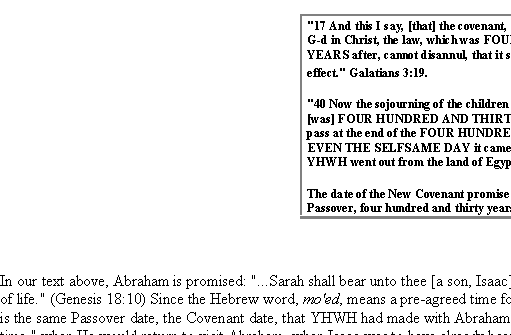
Passover is on the fourteenth day of the first Hebrew month, the month of Abib. Numbers 33:3 states that Israel left Rameses, Egypt on the fifteenth day of the
first month, on the “morrow after the Passover.” Exodus 12:40-41 says that the day that Israel left Egypt was exactly four hundred and thirty years, even the
selfsame day! Paul, in Galatians 3:19, states that the law that was given at Sinai cannot annul the covenant of promise that was made four hundred and thirty
years prior to the law that was given at Sinai. This makes the date of the New Covenant promise to be the SAME DATE as the Passover, four hundred and
thirty years prior to the Exodus! The date of this promise was so significant that its date had been preserved by Israel, even to the selfsame day of the Exodus
from Egypt. This means that the New Covenant – Abrahamic Promise was made on the SAME DATE as Passover! Significantly, the SAME DATE was
established PRIOR TO the SAME DATE when Israel had her Exodus from Egypt.
| “17 And this I say, [that] the covenant, that was confirmed before of G-d in Christ, the law, which was FOUR HUNDRED AND THIRTY YEARS after, cannot disannul, that it should make the promise of none effect.” Galatians 3:19. “40 Now the sojourning of the children of Israel, who dwelt in Egypt, The date of the New Covenant promise is the SAME DATE as the |
In our text above, Abraham is promised: “…Sarah shall bear unto thee [a son, Isaac], at this mo’ed, at this set time, in the next year,” (Genesis 17:21) “in the time
of life.” (Genesis 18:10) Since the Hebrew word, mo’ed, means a pre-agreed time for two or more persons to meet, this mo’ed, in the Spring, “in the time of life,”
is the same Passover date, the Covenant date, that YHWH had made with Abraham. It is important to note that YHWH did not newly establish a mo’ed, a “set
time,” when He would return to visit Abraham, when Isaac was to have already been born. No. YHWH speaks of “this set time,” “this mo’ed,” as already
existing. And, we know that this is true because during this same visit, YHWH informs Abraham that his seed should serve a nation and after four hundred years
of affliction (which began with the “affliction” of Isaac by Ishmael), Abraham’s seed would leave that nation with great substance. (Genesis 15:13-14) That
“leaving,” that “exodus” would (according to Exodus 12:40-41) occur 430 years, on the self-same day. But, that is 30 years more than the prophecy of 400
years. This means that the DATE of the New Covenant Promise to Abraham, being the SAME DATE as the Exodus, occurred 30 years PRIOR TO the visit
with Abraham at the Oaks of Mamre. For thirty years “this set time,” “this mo’ed” had already existed in significance to Abraham. For 430 years, this SAME
DATE was known and preserved so that Israel knew that when they left Egypt, it was the “SELF-SAME DAY.”
While having noted that the date of the New Covenant Promise to Abraham is the SAME date (430 years later) as Israel’s Exodus from Egypt, recapping,
Romans 9:9 uses the Greek word, kairos for the Hebrew word, mo’ed, in Genesis 17:21.
Please note that kairos is also used in Revelation 12:14 where the woman flees into the wilderness for a “time [kairos], times [kairos], and half a time [kairos]
from the face of the serpent.” In Daniel 12:7 the word, mo’ed, is used (corresponding to the Aramaic, Daniel 7:25) to describe a time, times and a half.
Revelation 12:14. “14 And to the woman were given two wings of a great eagle, that she might fly into the | Daniel 12:7. “7 And I heard the man clothed in linen, which [was] upon the waters of the river, when he |
As noted above, the Hebrew word, mo’ed, is translated as a “set time” and, it can refer to an annual “set time” or appointment. Thus, in our texts above, this is
like saying, One Christmas, two Christmases, and halfway to another Christmas. Some recent scholarship understands Daniel 12:7 to refer to a specific mo’ed, a
specific Feast.
By two New Testament witnesses, Romans 9:9 and Revelation 12:14, it is established that the Greek word, kairos is the equivalent of the Hebrew word, mo’ed.
kairos = mo’ed |
Acts 17:25-27, 30.
Having established that the Hebrew word, mo’ed, is translated as feast; and, having established that the Greek equivalent to the Hebrew word, mo’ed, is Strong’s
G2540, kairos, we are now ready to examine our primary text of this study.
The primary verses of this “response,” (to the assertion that there is no text in the New Testament that asserts that Gentiles were taught that they were required
to “keep,” “observe,” the Biblical Feasts), are Acts 17:25-27, 30. But, for context, verses 22 through 30 are here quoted:
- “22. Then Paul stood in the midst of Mars’ hill, and said, [Ye] men of Athens, I perceive that in all things ye are too superstitious.
- 23 For as I passed by, and beheld your devotions, I found an altar with this inscription, TO THE UNKNOWN GOD. Whom therefore ye ignorantly worship, Him declare I unto you.
- 24 G-d that made the world and all things therein, seeing that He is L-rd of heaven and earth, dwelleth not in temples made with hands;
- 25 Neither is worshiped with men’s hands, as though He needed any thing, seeing He giveth to all life, and breath, and all things;
- 26 And hath made of one blood all nations of men for to dwell on all the face of the earth, and hath determined the TIMES [Strong’s G2540, kairos] before appointed, and the bounds of their
habitation; - 27 That they should seek the L-rd, if haply they might feel after Him, and find Him, though He be not far from every one of us:
- 28 For in Him we live, and move, and have our being; as certain also of your own poets have said, For we are also His offspring.
- 29 Forasmuch then as we are the offspring of G-d, we ought not to think that the G-dhead is like unto gold, or silver, or stone, graven by art and man’s device.
- 30 And the times of this ignorance G-d winked at; but now commandeth all men every where to repent:” Acts 17:22-30.
Here, we see the apostle Paul visiting the unconverted Greek philosophers on Mars Hill. Let me emphasize that these are unconverted gentile Greeks. Paul takes
advantage of an altar that is addressed to “THE UNKNOWN GOD.” Paul informs the men at Mars Hill that He has come to declare this “Unknown G-d” to
them. He explains that this “Unknown G-d” created everything. Since the “Unknown G-d” created everything, it is impossible for “temples made with [human]
hands” to house Him. Further, neither is He worshiped with things that are made of man’s hands. I call to the reader’s attention that, contextually, Paul is
including the issue of “worship” in his declaration.
Then, in verses 25 and 26, Paul speaks of all the “nations of men.” He instructs the unconverted men of Mars Hill that the “Unknown G-d” has “determined the
TIMES before appointed” when (verse 27) “they” (“all nations of men”) “should seek YHWH”!! The English word, “times,” is translated from the Greek word,
kairos, which, as we have seen, is the Greek equivalent to the Hebrew word, mo’ed, which is translated as “feast” in Leviticus 23. We shall examine the Strong’s
numbers for each of the words, “determined the times before appointed,” as well as the meaning, shortly.
In verses 28 and 29, Paul addresses the issue of the worship of idols. Paul points out that even the Greeks’ own poets have declared that mankind is “the
offspring of G-d.” Since we, as “the offspring of G-d,” are not gold or silver or wood or stone, it follows that “the Unknown G-d” is also not made of gold or
silver or wood or stone. Then, in verse 30, summarizing, Paul instructs the unconverted gentile men at Mars Hill that in “the times of this ignorance G-d winked
at; but now commandeth all men every where to repent:” Of what are all men everywhere to repent? They are to repent of the specific points that Paul has laid
out for them:
- “All men every where” are to repent of thinking to house G-d in a building that they have made;
- “All men every where” are to repent of worshiping G-d with things that they have made;
- “All men every where” are to repent of seeking G-d at times appointed by men [implied] and to seek G-d at “times before appointed” that YHWH
Elohim determined when “all nations of men” should seek YHWH; and, - “All men every where” are to repent of worshiping images of gold, silver, wood, or stone and to worship He Whose “offspring” we are.
I cannot emphasize enough that Paul asserts to the unconverted Greeks at Mars Hill that “G-d…now COMMANDS all men every where to repent” regarding
these four points!
Let us now examine in more detail the words, “[G-d] hath determined the times before appointed” when “they” (“all nations of men”) should seek YHWH.”
The word, “determined,” is translated from the Greek word horizw.
- Strong’s G3724, horizw, 1) to define i.e.; 2) to mark out the boundaries or limits (of any place or thing [or time]; 3) to determine, appoint; that which has been appointed; to
ordain, determine, appoint.
The word, “times,” is translated from the Greek word kairos.
- Strong’s G2540, kairos, time, season, opportunity, due time, due measure, a measure of time, a larger or smaller portion of time, hence a) a fixed and definite time, the time when
things are brought to crises, the decisive epoch waited for, b) opportune or seasonable time, c) the right time, d) a limited period of time, e) to what time brings, the state of the
times, the things and events of time.
Above, it has been shown that the word, kairos, is the Greek equivalent of the Hebrew word, mo’ed. Further, it has been shown that the word, mo’ed, is
translated as “feast” in Leviticus 23.
The words, “before appointed,” are translated from the Greek word, Strong’s G4384, protas’so.
- Strong’s G4384, protas’so, from G4253 and G5021, 1) to place before; 2) to appoint before, define before hand.
The apostle Paul instructs the unconverted gentile Greeks at Mars Hill, that the “Unknown G-d” “determined” (“marked out the boundaries” of the “times” (the
set appointments, YHWH’s Feasts) that He “before appointed” (“defined before hand”) at which “time” “they” (“all nations of men”) should seek YHWH!
WHEN did YHWH Elohim “define before hand” to “mark out the boundaries” of the “set appointments” of time when “all nations of men” should
seek Him? YHWH Elohim marked out the boundaries of the set appointments, the mo’edim, the Feasts, at creation, when He created the sun, moon
and stars:
- “14. And Elohim said, Let there be lights in the firmament of the heaven to divide the day from the night; and let them be for signs, and for SEASONS [Strong’s H4150, mo’ed], and for days, and
years: - 15 And let them be for lights in the firmament of the heaven to give light upon the earth: and it was so.
- 16 And Elohim made two great lights; the greater light to rule the day, and the lesser light to rule the night: [he made] the stars also.” Genesis 1:14-15.
- “19. He appointed the moon for SEASONS [Strong’s H4150. mo’ed]: the sun knoweth his going down.” Psalm 104:19.
In order to “define before hand” the “kairos/mo’ed” when “all nations of men” should seek YHWH, YHWH had to “define before hand” and “mark out the
boundaries” BEFORE any nation of men existed! Paul is explicit. “All nations of men” are to seek YHWH at the “kairos/mo’ed” that YHWH had “before
appointed.” This means that the “kairos/mo’ed” were “before appointed” BEFORE the nations of men existed. And, Genesis 1:14-16 informs us that at creation,
YHWH Elohim demarcated the mo’ed (KJV: “seasons”) PRIOR TO the creation of Adam and all the subsequent “nations of men.” It is the cycles of the sun,
moon and stars that “mark out the boundaries” of the mo’edim. Psalm 104:19 specifically states that the “moon was made for the mo’edim.” The Biblical Feasts
are all defined by the count of days from the new moon of the first month (Abib) or, the new moon of the seventh month (Tishre).
| The apostle Paul instructs the unconverted gentile Greeks at Mars Hill, that the “Unknown G-d” “determined” (“marked out the boundaries” of the “times” (the set appointments, YHWH’s Feasts) that He “before appointed” (“defined before hand”) at which “time” “they” (“all nations of men”) should seek YHWH! It must be further pointed out that since the boundaries of the |
It must be further pointed out that since the boundaries of the kairos/mo’ed were “marked out” by the creation of the sun, moon and stars, PRIOR TO the
creation of Adam, it follows that those same boundaries of Sacred Appointments (YHWH’s Feasts) were also “marked out” PRIOR TO the fall of Adam and the
addition of the law that was “added because of transgressions” (Galatians 3:19), i.e., the sacrificial laws! Consequently, the kairos/mo’ed CANNOT belong to the
law that was “added because of transgressions” (commonly referred to as the “ceremonial law”)!!
I conclude that contrary to the common opinion that there is no text in the New Testament that teaches that G-d requires (“commands”) “all men every where”
to keep the Biblical Feasts, there is such a text and that text is found in Acts 17:25-27, 30.
Above, it was noted that Paul asserted to the Greek at Mars Hill that YHWH is not housed in temples made with hands nor is “worshiped” by things that are
made with hands. Below, we shall examine Yahushua’s words, “My house shall be called of all nations the house of prayer.” We shall examine these words in
light of the words that “My house” was called, the “Tabernacle of the Mo’edim”! But, first, we shall examine four additional supporting texts to the idea that Paul
taught gentiles to observe the Feasts.
Before leaving this portion of our study, I need to note to the reader that the Scriptures teach that the Biblical Feasts existed even PRIOR TO the creation of our
solar system. In my paper, THE BIBLICAL FEASTS AND THE EVERLASTING GOSPEL, BELONGING TO THE MYSTERY HID FROM BEFORE THE
FOUNDATION OF THE EARTH, I lay out the Scriptural evidence that the Biblical Feasts existed in Heaven PRIOR TO the fall of Lucifer. As described in the
book of Job (chapters one and two), these were the “time[s]” when the [unfallen] “sons of G-d came to meet” with YHWH their Creator. (Job 1:6; 2:1) In the
creation of our world, YHWH created the sun and moon, with their cycles, to demarcate for the soon to be created, Adam, the already existing mo’edim,
YHWH’s Feasts. As a “son of G-d,” Adam was to join the “sons of G-d” in assembly before YHWH. (Psalm 82:1) When Adam sinned, he transferred his
dominion of the earth to him who he had obeyed in eating of the Tree of the Knowledge of Good and Evil. Having received this transference of dominion, in the
book of Job, Satan meets with the other “sons of G-d” representing planet Earth. The pre-incarnate Yahushua immediately contests Satan’s representation of
planet Earth. He says, “Hast thou considered my servant Job?” (Job 1:8) On judgment day, these words get repeated in respect to the 144,000, whom Job
pre-figures.
Acts 13:42-44,
Gentiles Meet to Hear the Gospel on the Sabbath.
Since Leviticus 23:1-4 lists the seventh-day Sabbath as the first of YHWH’s Feasts, it is essential to note Acts 13:42-44:
- “42. And when the Jews were gone out of the synagogue, the Gentiles besought that these words might be preached to them the next Sabbath.
- 43 Now when the congregation was broken up, many of the Jews and religious proselytes followed Paul and Barnabas: who, speaking to them, persuaded them to continue in the grace of G-d.
- 44 And the next Sabbath day came almost the whole city together to hear the word of G-d.” Acts 13:42-44.
Gentiles entreat the apostle Paul to teach them the same words of the Gospel on the following seventh-day Sabbath. This event took place in “Antioch in Pisidia”
(see verse 14). Also, from verse 14, we know that this event took place on the seventh-day Sabbath. We know that it was the seventh-day Sabbath (and not the
first day of the week) because the Jews were assembled together in the synagogue. As was Paul’s custom, Paul took the gospel FIRST to the Jews. (Romans
1:16) He met with them in the synagogue on the seventh-day Sabbath. If the Sabbath had been changed to the first day of the week, Paul would have taught the
Gentiles on the following morning! No! It is the following seventh-day Sabbath that nearly the whole Gentile city comes together to hear the words of the
gospel!
Nearly all the Gentiles of the City of Antioch in Pisidia assembled to hear Paul preach the words of the Gospel on YHWH’s Feast: the Seventh-day Sabbath. |
Paul’s Admonition to the Greek Corinthians to
“Continue Keeping the Feast [of Unleavened Bread].”
In addition to Acts 17:25-27, 30, 1Corinthians 5:6-8 is another text that supports the idea that the apostle Paul taught gentiles to observe the Biblical Feasts.
In 1Corinthians 5:1, Paul reports to the Corinthians that he has learned that one of their members is living, with “fornication,” with his father’s wife. Paul rebukes
the Corinthians for not even mourning that this fornicator has not been removed from among them. Paul instructs the Corinthians to judge and remove this man
from among their midst. Then, Paul draws upon the Torah laws requiring the removal of leaven during the Feast of Unleavened Bread.
- “6 Your glorying [is] not good. Know ye not that a little leaven leaveneth the whole lump?
- 7. Purge out therefore the old leaven, that ye may be a new lump, as ye are unleavened. For even Christ our Passover is sacrificed for us:
- 8 Therefore let us keep the feast, not with old leaven, neither with the leaven of malice and wickedness; but with the unleavened [bread] of sincerity and truth.” 1Corinthians 5:6-8.
When the apostle Paul instructs the Greek believers at Corinth to “purge out the old leaven,” to “keep the feast [of unleavened bread], he instructs them based
upon the authority of Exodus 13:7:
- “7 Unleavened bread shall be eaten seven days; and there shall no leavened bread be seen with thee, neither shall there be leaven seen with thee in all thy quarters.” Exodus 13:7.
The common theology is that either the whole law of Moses or, at minimum, all the laws pertaining to animal sacrifices, i.e., the “Ceremonial Law,” were
abolished at the death of Messiah Yahushua, having been “nailed to the cross.” (Colossians 2:14) Further, the common theology is that the Feast Days, with ALL
associated rituals, belong to the Law of Sacrifices (Ceremonial Law). What, then, is Paul doing requiring Greeks to observe (if only in metaphoric principle) this
ritual of the removal of leaven of the Law of Moses? This “ceremonial law”?
The context of these verses describe Paul’s call to disfellowship an immoral professed believer who was living with his father’s wife. The anti-type of leaven, the
“leaven of malice and wickedness” was to be removed from G-d’s house, the spiritual corporate temple of the church at Corinth.
Also, the phrases, “as ye are unleavened” and “not with old leaven, neither with…” indicate that Paul taught the Corinthian believers to remove literal leaven from
their homes as per the requirement of the law. The words, “as ye are unleavened” could refer to either being literally “unleavened” (that is, having removed literal
leaven from their homes during the literal Feast of Unleavened Bread) or, to being spiritually “unleavened” (that is, sin and wickedness has been removed from
the Corinthian believers, individually and corporately). I hold that BOTH are true. But, when the apostle Paul instructs the believers at Corinth that they are to
keep the feast [of unleavened bread] “not with old leaven, neither with the leaven of malice and wickedness,” he demands BOTH a literal removal of leaven and a
metaphoric removal of leaven. If the words, “not with old leaven” are intended to be metaphoric, then Paul is being redundant: “not with [metaphoric] old
leaven, neither with the [metaphoric] leaven of malice and wickedness.” Holding that Paul is not being redundant, the words, “not with the old [literal] leaven,
neither with the [metaphoric] leaven of malice and wickedness,” demand that Paul instructed the believers at Corinth that there was to be BOTH a literal and a
spiritual/metaphoric removal of “leaven” from amongst their midst.
According to the SDA Bible Commentary, the tensing of the Greek word translated “keep” in the phrase, “Therefore let us keep the feast,” is “continue
keeping.” (S.D.A. Bible Commentary, vol. 6, page 691) Therefore, the phrase should read, “Therefore let us continue keeping the feast [of Unleavened Bread].”
The idea of the “continuation” of keeping the Feast of Unleavened Bread asserts that there was an already existing observance of the Feast of Unleavened Bread
which is to “continue.”
Summarizing, in 1Corinthians 5:6-8, the apostle Paul instructs the believers in the Greek city of Corinth (which was likely a mixed congregation of believing
Jews and converted Greeks) that they are to “continue keeping the Feast of Unleavened Bread,” by the continued removal of literal leaven during the Feast of
Unleavened Bread to commemorate their continuing state of being removed of the spiritual/metaphoric leaven of malice and wickedness.
The Apostle Paul Instructed the mixed congregation of Jews and Greeks, at Corinth, To “Continue Keeping” The Feast of Unleavened Bread! |
The Philippians Keep the Feast of Unleavened Bread
With the Apostle Paul.
Acts 17:25-27, 30, is also supported by Acts 20:6, where we are informed that the Philippians joined the apostle Paul in keeping the Feast of Unleavened Bread.
- “6 And we sailed away from Philippi after the DAYS OF UNLEAVENED BREAD, and came unto them to Troas in five days; where we abode seven days.” Acts 20:6.
Of this event, Ellen White writes:
- “At Philippi Paul tarried to keep the Passover. Only Luke remained with him, the other members of the company passing on to Troas to await him there. The Philippians were
the most loving and truehearted of the apostle’s converts, and during the eight days of the feast he enjoyed peaceful and happy communion with them.” Ellen G. White, Acts of the
Apostles, pages 390-391. (The eight days of the feast, referred to by Ellen White in this quote, are Passover and the seven days of the Feast of Unleavened Bread.)
History records that there was no synagogue in Philippi. If there were Jews in Philippi (and there might have been), there were insufficient numbers to populate
and support a synagogue. This implies that most, of the converts in Philippi were not Jewish, but rather Gentile. I say, “most of the converts were not Jewish”
because in Acts 16:13 there is evidence that some were Jewish.
- “12 And from thence to Philippi, which is the chief city of that part of Macedonia, [and] a colony: and we were in that city abiding certain days.
- 13 And on the Sabbath we went out of the city by a river side, where prayer [Strong’s G4335, proseuch/e] was wont [Strong’s G3435, nomizw] to be made; and we sat down, and spake unto the
women which resorted [thither].” Acts 16:12, 13.
I have highlighted [bolded] the words, “prayer” and “wont,” referencing the Strong’s numbers from which these words are translated.
- Strong’s G4335, proseuch/e: 1) prayer addressed to G-d; 2) a place set apart or suited for prayer; i.e. a synagogue; 2a) a place in the open air where the Jews were wont to pray,
outside of the cities, where they had no synagogue; such places were situated upon the bank of a stream or the shore of a sea, where there was a supply of water for the washing of
hands before prayer. - Strong’s G3435, nomizw: 1) to hold by custom or usage, own as a custom or usage, to follow a custom or usage; it is the custom, it is the received usage; 2) to deem, think, suppose.
Imagine my surprise that Strong’s Exhaustive Concordance provided so much information about this place of prayer outside of Philippi! A few texts help to
explain the need for water in relationship to worship and prayer:
When Israel was to hear the words of the covenant from mount Sinai, they were to wash their clothes. (Exodus 19:11, 15) When the priests were to approach
either the Altar of Burnt Offering or the Tabernacle, they were to first approach the laver and wash both their hands and their feet. (Exodus 30:18-21) And, in
relationship to prayer:
- “3. Who shall ascend into the hill of YHWH? or who shall stand in His holy place?
- 4 He that hath clean hands, and a pure heart; who hath not lifted up his soul unto vanity, nor sworn deceitfully.” Psalm 24:3, 4.
- “15 And when ye spread forth your hands, I will hide mine eyes from you: yea, when ye make many prayers, I will not hear: your hands are full of blood.
- 16. Wash you, make you clean; put away the evil of your doings from before mine eyes; cease to do evil;
- 17 Learn to do well; seek judgment, relieve the oppressed, judge the fatherless, plead for the widow.
- 18 Come now, and let us reason together, saith YHWH: though your sins be as scarlet, they shall be as white as snow; though they be red like crimson, they shall be as wool.” Isaiah 1:16.
The spiritual cleansing of the inner soul and the outward deeds were symbolized by the washing of the hands (and feet). Consequently, where there was no
synagogue, there was a need to be in a place where there was moving water, either the wave action of the sea or the running water of a stream. The place needed
to be apart from any location of idolatry. Hence, the country place, outside of the city.
What this means is either that some Jews already lived in Philippi or, else, the Gentile converts were observing the non-blood ritual(s) of the washing of hands
prior to prayer. The use of Strong’s G3435, nomizw, that has the meaning of “performing by custom,” indicates to me that the place where prayer was wont to
be made, was a place where the customs associated with prayer were performed. The place of prayer outside of Philippi, near the river, was already the place of
prayer, used by those who needed such a place to perform the customs associated with prayer, i.e. washing hands with running water. Conclusion: Some Jews
lived at Philippi.
In Philippi, Where there was no Jewish synagogue, (but may have been some Jews), Believers at Philippi Kept the Feast of Unleavened Bread with the apostle Paul. |
Having reached this conclusion, some might argue that Jews at Philippi would naturally observe the Feast of Unleavened Bread. Point taken. But, it is generally
believed that since there was no synagogue in Philippi, at the least, the majority of believers were Gentile. Whether the believers at Philippi were all Jews or only
a few Jews and a majority of Gentiles, the point is that when Paul returns to Philippi in Acts 20:6, the believers keep the Feast of Unleavened Bread with him.
Paul’s Approval
That the Church at Thessalonika
Patterned Their Church After the Churches in Judea.
In 1Thessalonians 2:14, we find another text that indirectly supports the idea that Paul taught the Gentile churches to observe the Biblical Feasts. In
1Thessalonians 2:14, Paul approves of the Thessalonians for being followers of the churches in Judea.
- “14 For ye, brethren, became followers [Strong’s G3402, mim/et/es, follower, imatator, from G3401, mimeomai, to mimic] of the churches of Elohim which in Judaea are in Messiah Yahushua: for
ye also have suffered like things of your own countrymen, even as they [have] of the Jews:” 1Thessalonians 2:14.
First, take note that Paul seems to be addressing Gentile believers in Thessalonika. This assertion is drawn from the parallel of the last phrases of this verse.
“Ye [Thessalonika believers] also have suffered like things of your own countrymen,
even as
they [Judaen believers] [have] of the Jews:”
The word, “your own countrymen,” imply that the Thessalonian believers were “gentile” like their own countrymen.
Paul informs us that the Thessalonians “became followers of the churches of Elohim which are in Judaea.”
Then, in Acts 21:20, Paul is told of the many thousands of Judean believers that are “zealous for the law.”
- “20 And when they heard [it], they glorified the Lord, and said unto him, Thou seest, brother, how many thousands of Jews there are which believe; and they are all zealous of the law:” Acts
21:20.
Acts 21:20 informs us that the “many thousands of Jews…which believe” were “all zealous of the law.” The Greek word that is translated as “law” is nomos.
Although nomos” can refer to any law, the most frequent use of nomos” in the New Testament is while referencing the Law of Moses, the Torah. This means
that Paul spoke approvingly of the believers of Thessalonika, in that they “followed” (patterned themselves after) the churches in Judaea, which were all zealous
for the Torah! Being zealous for the Torah asserts that all of the Torah was being observed by the Judean churches, including the Biblical Feasts. This implies
that, like their brethren in Judaea, the believers of Thessalonika also kept the Biblical Feasts.
The Apostle Paul Approved That the Church at Thessalonika Followed (Mimicked) Their Brethren in Judea Who were Zealous for the Torah, Including the Implied Observance of the Biblical Feasts!! |
Seeking YHWH at the Times Before Appointed,
“My House, the Tabernacle of the Mo’edim,
Shall be Called an House of Prayer for All Peoples.”
In our primary text, Acts 17:25-27, 30, it was pointed out that the apostle Paul taught the unconverted gentile Greeks at Mars Hill that they were to repent and
were commanded of G-d that “all nations of men” should seek YHWH at the kairos/moed/Feasts that YHWH had determined before there ever was a nation. In
light of the idea that “all nations of men” should seek YHWH at His “kairos/mo’ed/Feasts,” it is important to note that Yahushua taught:
- “17 And he taught, saying unto them, Is it not written, My house shall be called of all nations the house of prayer? but ye have made it a den of thieves.” Mark 11:17.
Yahushua spoke these words in the context of a Feast, Passover. He spoke them in the context of “removing the leaven of malice and wickedness” from His
“house” in anticipation of Passover and the Feast of Unleavened Bread. When Yahushua ha’Messhiach spoke these words, He was quoting from Isaiah 56:7:
- “6 Also the sons of the stranger, that join themselves to YHWH, to serve Him, and to love the Name of YHWH, to be His servants, every one that keepeth the Sabbath from polluting it, and taketh
hold of My covenant; - 7 Even them will I bring to My holy mountain, and make them joyful in My house of prayer: their burnt offerings and their sacrifices [shall be] accepted upon Mine altar; for Mine house shall be
called an house of prayer for all people.” Isaiah 56:6-7.
A “stranger” is a non-Israelite. A “stranger” was one who had not joined himself to YHWH and to YHWH’s people and to YHWH’s covenant(s). A “stranger”
was a “gentile.”
This concept that YHWH’s “house” is to be called a “house of prayer for all nations” is also supported by the following words from Solomon’s prayer at the
dedication of Solomon’s Temple:
- “41 Moreover concerning a stranger, that [is] not of Thy people Israel, but cometh out of a far country for Thy Name’s sake;
- 42 (For they shall hear of Thy great Name, and of Thy strong hand, and of thy stretched out arm;) when he shall come and pray toward this house;
- 43 Hear Thou in heaven thy dwelling place, and do according to all that the stranger calleth to Thee for: that all people of the earth may know Thy Name, to fear thee, as [do] Thy people Israel;
and that they may know that this house, which I have builded, is called by Thy Name.” 1Kings 8:41-43.
Solomon’s Temple was to be a “house of prayer” for the “stranger” and for “all people of the earth.”
But, Herod’s Temple, Zerubbabel’s Temple, and Solomon’s Temple were all expansions on the theme of the Mosaic Tabernacle. Each followed the general
pattern of a courtyard where sacrifices were slaughtered and offered upon the Altar of Burnt Offering; a Holy Place wherein was placed at least a “candlestick”
and a “table of shewbread” and the golden “Altar of Incense”; and, the Most Holy Place wherein was (or, was supposed to be) the “Ark of the Covenant.” The
design also followed the “pattern” that the only way into each of these three primary aspects of the Temple was from the East. Having expanded upon the pattern
of the Mosaic Tabernacle, it is significant that the Mosaic Tabernacle was called, The Tabernacle of the Mo’edim. (KJV: tabernacle of the congregation; RSV:
tent of meeting)
- “21 In the tabernacle of the congregation [Strong’s H4150, mo’ed] without the vail, which [is] before the testimony, Aaron and his sons shall order it from evening to morning before YHWH: [it
shall be] a statute for ever unto their generations on the behalf of the children of Israel.” Exodus 27:21. (And 121 other instances between Exodus and Deuteronomy.)
Thus, when Yahushua ha’Messhiach taught that His house was to be a “house of prayer for all nations,” He spoke of the expanded motif of the “Tabernacle of
the Mo’edim.” His “house of prayer” is His house of the Sacred Appointments, YHWH’s Feasts. Yahushua’s “House” of the Mo’edim is the place toward which
the strangers are to pray to seek YHWH at the “times [kairos/mo’ed] before appointed.”
Yahushua Taught: “My House, the Tabernacle of the Mo’edim, Shall be Called an House of Prayer for All Peoples.” |
Revelation 7:9-10:
The Great Multitude and the Feast of Tabernacles.
The issue being examined in this study is whether Gentile believers were taught to keep the Biblical Feasts. In Revelation 7:9-10, we read of a prophecy that “a
great multitude” “of all nations” are going to be keeping the Feast of Tabernacles.
- “9 After this I beheld, and, lo, a GREAT MULTITUDE, which no man could number, of ALL NATIONS, and kindreds, and people, and tongues, stood before the throne, and before the Lamb,
clothed with white robes, and palms in their hands; - 10 And cried with a loud voice, saying, Salvation to our God which sitteth upon the throne, and unto the Lamb.” Revelation 7:9-10.
In these verses it is the combination of being dressed in white robes, holding palm branches, and the singing of the Hallel, (Psalm 113-118) that combine to
describe the observance of the Feast of Tabernacles.
If I describe colored eggs and chocolate bunnies, you would respond that I am describing Easter. If I describe carved pumpkins, witches outfits, etc., you would
respond that I am describing Halloween. If I describe an ornamented evergreen tree, and mistletoe, you would respond that I am describing “Christmas.” So it is
with these verses. The being clothed in white robes, holding palm branches and singing from Psalm 118:25 are a combination of elements that describe the
observance of the Feast of Tabernacles.
Regarding the white robes, I read once that Israel would assemble in the Temple, particularly on the last day of the Feast, the eighth day, dressed in white robes.
I have not found my reference. So, for now, set this aside.
The holding of palm branches is part of the command recorded in Leviticus 23:40:
- “40 And ye shall take you on the first day the boughs of goodly trees, branches of palm trees, and the boughs of thick trees, and willows of the brook; and ye shall rejoice before YHWH your
Elohim seven days.” Leviticus 23:40.
In his book, The Temple, Its Ministry and Services As They Were in the Time of Jesus Christ, Alfred Edersheim (a converted Jew) records the following
regarding the waving of the palm branches and boughs of goodly trees:
- “It has already been noticed that, according to the view universally prevalent at the time of Christ, the direction on the first day of the feast to ‘take the fruit of goodly trees,
branches of palm trees, and the boughs of thick trees, and willows of the brook,’ was applied to what the worshippers were to carry in their hands. The Rabbis ruled, that ‘the
fruit of the goodly trees’ meant the aethrog, or citron, and ‘the boughs of thick trees’ the myrtle, provided it had ‘not more berries than leaves.’ The aethrogs must be without
blemish or deficiency of any kind; the palm branches at least three handbreadths high, and fit to be shaken; and each branch fresh, entire, unpolluted, and not taken from any
idolatrous grove. Every worshipper carried the aethrog in his left hand, and in his right the lulav, or palm, with myrtle and willow branch on either side of it, tied together on the
outside with its own kind, though in the inside it might be fastened even with gold thread. There can be no doubt that the lulav was intended to remind Israel of the different
stages of their wilderness journey, as represented by the different vegetation—- palm branches recalling the valleys and plains, the ‘boughs of thick trees,’ the bushes on the
mountain heights, and the willows those brooks from which God had given His people drink; while the aethrog was to remind them of the fruits of the good land which the Lord
had given them. The lulav was used in the Temple on each of the seven festive days, even children, if they were able to shake it, being bound to carry one.” Alfred Edersheim, The
Temple, page 179.
Of the singing of the Hallel (Psalm 113-118), Edersheim states:
- “As soon as the wine and the water were being poured out, the Temple music began, and the ‘Hallel’ (Psa 113-118) was sung in the manner previously prescribed, and to the
accompaniment of flutes, except on the Sabbath and on the first day of the feast, when flute-playing was not allowed, on account of the sanctity of the days. When the choir came
to these words (Psa 118:1), ‘O give thanks to the Lord,’ and again when they sang (Psa 118:25), ‘O work then now salvation, Jehovah’; and once more at the close (Psa 118:29), ‘O
give thanks unto the Lord,’ all the worshippers shook their lulavs towards the altar.” Edersheim, The Temple, page 182.
| In Response to the assertion that there is no text in the New Testament that requires Gentiles to observe the Biblical Feasts, Revelation 7:9-10 describes “a great multitude” “of all nations” intentionally observing the combined details of the liturgical singing of Psalm 118:25 with the simultaneous waving of palm branches that occurred during the Feast of Tabernacles: A Great Multitude of All Nations Shall Observe (with detailed knowledge) the Feast of Tabernacles. |
The words, “O work then now salvation, Jehovah [YHWH]” of Psalm 118:25 are rendered in the KJV English translation of the Greek from Revelation 7:10 as,
“Salvation to our G-d.” According to Edersheim, it was when the worshipers came to the words, “O work then now salvation, YHWH,” that they shook their
lulavs. Of the lulavs, it was particularly the palm branch that was shaken or, waved. It is to the liturgical timing of the Temple worship event during the Feast of
Tabernacles that Revelation 7:9-10 refers! What is significant to our study is that it is a great multitude from all nations who cry for this salvation with the cry of
faith, who cry this cry of faith with intention during the Feast of Tabernacles! This great multitude from all nations worships with knowledge of the Temple
service. They comprehend the significance of combining the timing of the liturgical singing of the Hallel, specifically of Psalm 118:25, with the waving of the
palm branches of the lulav. They are intentionally observing these combined details of worship that occurred during the Feast of Tabernacles! They, a great
multitude of all nations, are keeping the Feast of Tabernacles!
Summary.
In response to the assertion that there is no text in the New Testament that requires gentile believers New Covenant believers to observe the Biblical Feasts: Yes,
there is such a text. That text is Acts 17:25-27. It is supported by 1Corinthians 5:7-8, 1Thessalonians 2:14, Mark 11:17 and, predicted in part by Revelation
7:9-10.
In order to appreciate whether the Biblical Feasts belong to the original covenant and, hence, to the New Covenant, some basics about ancient covenants and the
Biblical covenants needed first to be understood. Several aspects of both the Sinai covenant and the “New Covenant” were examined. These basic aspects of
ancient and Biblical covenants were:
- When a covenant was “made,” it was “cut.”
- Anciently, the SAME words of a covenant were written BOTH upon a “tablet” AND in a “book” (scroll). (Isaiah 30:8.
- Nehemiah 9:13-14 describes YHWH having spoken from Mount Sinai essentially the SAME divisions of the words of the covenant as were written
by the hand of Moses. The primary divisions of the words of the covenant were: commandments, statutes and, judgments. - The Biblical Feasts are statutes and judgments.
- The Ten Commandments are Ten Words, the Decalogue. The Hebrew word that is translated as “commandments, in the words, Ten
Commandments, is debarim. The Hebrew word, debar, can mean a single word. Or, it can mean a whole matter/subject that is spoken about. (E.g.
Esther 9:26) The Ten Words are, then, Ten summary Words of Ten Topics discussed in detail in the Book of the Covenant. - Analyzing Exodus 34:10-28, we learned that the Ten Commandments (Ten Words) are a summary of the elements of the covenant made with Israel
at Sinai. The Biblical Feasts are specifically included in Exodus 34’s overview of the terms of the covenant. The Fourth Commandment is the
“Summary Word” regarding the Biblical Feasts and the Land Sabbaths. - A couple places in the New Testament records the continuation of the terms of YHWH’s covenant (what was written in stone (the Ten
Commandments) and what was written with ink (the Torah) are now written in the hearts of the New Covenant believers by the Holy Spirit. We
learned that Hebrews 8:7-13 and 10:22 specifically defines the New Covenant by alluding to Jeremiah 31:31-35 and to Ezekiel 36:26-27. There we
find that it is the statutes and judgments of the Torah, the Book of the Covenant that particularly comprises the “law” that is to be written upon
our hearts. - Along the way, we learned that the Biblical Feasts were included in the portion of the Book of the Covenant PRIOR TO Israel’s worship of the
golden calf and PRIOR TO the Scriptural record of the laws of the sacrificial system.
In order to appreciate the significance of Acts 17:25-27, 30, we next examined the meaning of Galatians 3:19’s “law” that was “added because of transgression.”
We learned that “where there is no law, there is no transgression.” (Romans 4:15) Which means that a “law” first existed, which was then “transgressed.” Then,
an other “law” was “added because of transgression.” We learned that YHWH’s mo’edim existed PRIOR TO transgression (either by Adam and Eve or by Israel
at Sinai). And, we learned that the “law” that was “added because of transgression” was the law of sacrifices. And, we learned that since the mo’edim existed
PRIOR TO the transgression, the mo’edim CANNOT belong to the “law of sacrifices” that was subsequently added AFTER transgression.
In order to appreciate the Greek word, kairos, in Acts 17:26, we learned that the Hebrew word, mo’ed, (that is translated as “feast” in Leviticus 23), is translated
into Greek as kairos in Romans 9:9 and Revelation 12:14. Thus, it was established that the Greek word, kairos, is equivilent to the Hebrew word, mo’ed.
In Acts 17:25-27, 30, the apostle Paul instructs the unconverted gentile men at Mars Hill that in “the times of this ignorance G-d winked at; but now
commandeth all men every where to repent:” Of what are all men everywhere to repent? They are to repent of the specific points that Paul has laid out for them:
- “All men every where” are to repent of thinking to house G-d in a building that they have made;
- “All men every where” are to repent of worshiping G-d with things that they have made;
- “All men every where” are to repent of seeking G-d at times appointed by men [implied] and to seek G-d at “times [Feasts: kairos/mo’ed] before
appointed” that YHWH Elohim determined when “all nations of men” should seek YHWH; and, - “All men every where” are to repent of worshiping images of gold, silver, wood, or stone and to worship He Whose “offspring” we are.
In Acts 17:25-27, 30, the apostle Paul clearly teaches unconverted Greeks that they, and all nations of men, are to seek YHWH at the Feasts, whose appointed
times to seek YHWH, were demarcated for mankind during the creation week by the creation of the sun and moon (with their cycles), before there ever was a
nation. Comprehending the pre-creation of man existence of YHWH’s Feasts demands that the Biblical Feasts CANNOT belong to the law that was added
because of transgression, the law of sacrifices (commonly called the Ceremonial Law).
In this study we also learned that the DATE of the making of the New Covenant promise with Abraham was the SAME DATE as the Exodus from Egypt. That
DATE is the fourteenth-fifteenth of the first Hebrew month, Abib. Consequently, the DATE of the New Covenant promise, being the SAME DATE as the Old
Covenant Exodus from Egypt, is significant PRIOR TO the association that is commonly made between YHWH’s Feasts and the Old Covenant! The DATE: the
fourteenth-fifteenth of the month of Abib is significant FIRST to the New Covenant Promises made to Abraham, 430 years PRIOR TO the giving of the law
from Sinai, 430 years PRIOR TO the “ADDITION of the Sacrificial Laws” because of Israel’s worship of the golden calf.
We also learned that the apostle Paul taught nearly all of the Gentiles of the city of Antioch in Pisidia the gospel on YHWH’s Feast: the Seventh-day Sabbath. If
Sunday was “the Lord’s Day,” Paul had every opportunity to instruct the Gentiles on the morning AFTER he had taught the Jews in their synagogue. The
Gentiles requested to be taught the following seventh-day Sabbath. And, Paul taught (not on the following morning – Sunday) on YHWH’s Feast: the
Seventh-day Sabbath a week later.
We also learned that the apostle Paul taught the mixed congregation at Corinth to “continue keeping the Feast [of Unleavened Bread]” by the removal of literal
leaven to commemorate that they, themselves are spiritually unleavened.
We also learned that Yahushua ha’Messhiach (KJV: Jesus Christ) taught that His House (the Temple) (precursored by the Mosaic, Tabernacle of the Mo’edim,
(RSV: Tent of Meeting), the Tabernacle of the Feasts), was to be a house of prayer for all nations. Yahushua made this statement in the context of Passover and
cleansing His House from the “leaven of malice and wickedness” of the money changers. Consequently, Yahushua’s “House” is His House of the Sacred
Appointments, the Feasts, when all nations of men should seek YHWH at the times before appointed before there ever was a nation.
We learned that in the city of Philippi, where historically there is no record of a synagogue being in that city, the Philippian believers joined Paul in keeping the
Feast of Unleavened Bread. Although within the text of Scripture there is evidence that some Jews did live in Philippi, it is generally believed that the majority of
believers at Philippi were Gentile.
And, from Revelation 7:9-10, we learned that a time shall come when a great multitude of all nations shall keep the Feast of Tabernacles. They shall keep the
Feast of Tabernacles with a detailed knowledge of the liturgical worship that occurred during the Feast of Tabernacles.
In this study, I have intentionally left off Paul’s discussion with the Ephesians about how that they were once “aliens from the commonwealth of Israel and
strangers from the covenants of promise. (Ephesians 2:111-13) And, I have left off Paul’s discussion in Romans 11, regarding the grafting-in of the Gentiles into
the “olive tree.” Discussing these texts would have added more pages to this study, when it is already larger than I originally wanted.
In this study, I have intentionally left off Colossians 2:14-17, which, if correctly understood, is one of the strongest texts in the New Testament that shows that
the believers of Colossae were instructed to not allow any man to judge their manner of observance of “feast days, new moons, and Sabbaths” “which are a
shadow of things to come.” The examination of Colossians 2:14-17 is a large study and would have distracted from the importance of Acts 17:25-27, 30.
I urge the reader to separately acquire my studies on Colossians 2:14-17. Particularly, to those who favor the doctrines of Justification by Faith and
Righteousness by Faith, please read my studies on Colossians 2:13-17.
In this study, I have also intentionally left off those several texts that describe the apostle Paul’s observance or intent to observe the Feasts. (E.g., Acts 18:21) My
intent, in this paper, is to focus on those texts that describe Gentiles observing the Biblical Feasts or, being instructed that they are to seek YHWH at His Sacred
Appointments, the Biblical Feasts.
The conclusion of this study is that the New Testament does teach that unconverted Gentiles were taught to repent and seek YHWH at the “times,” the Feasts
that YHWH demarcated for man by the sun and moon (with their cycles) PRIOR TO the creation and subsequent fall of man. YHWH’s Mo’edim (Feasts) existed
PRIOR TO the law of sacrifices that was “added” to Adam and Eve, as evidenced by the provision of the “skins” that were made for Adam and Eve to “cover”
their nakedness. (Genesis 3:6-7, 21) The DATE of Israel’s Passover (14th-15th of Abib) is the SAME DATE as the DATE of the New Covenant promise that
was made to Abraham 430 years PRIOR TO the Exodus “on the self-same day.” (Exodus 12:40-42; Galatians 3:19) [I cannot emphasize to you dear reader how
significant it is that the DATE of Israel’s Exodus is associated to the New Covenant promise PRIOR TO its association to the history of literal Israel!] And, as
noted above, the Biblical Feasts were included in the Book of the Covenant PRIOR TO Israel’s worship of the golden calf, which was then, PRIOR TO the “law”
that was “added because of transgression,” the law of sacrifices and all associated blood ritual laws. Further, since YHWH’s Feasts were established PRIOR TO
THE CREATION OF Adam and Eve, PRIOR TO the fall of Adam, PRIOR TO the covenants made with Abraham, and PRIOR TO the Exodus, PRIOR TO
Israel’s worship of the golden calf and the subsequent “addition” of the law that was “added” because of the transgression of worshiping the golden calf, the
Biblical Feasts CANNOT belong to the law of sacrifices that was added because of transgression!
Comprehending that YHWH’s Feasts CANNOT belong to the law that was added because of transgression (Galatians 3:19), means that YHWH’s Feasts WERE
NOT ABOLISHED upon the death of Messiah Yahushua. Yea, YHWH’s Sacred Appointments were more fully established as pertaining to mysteries that were
to be unfolded in the New Covenant plan of redemption.
Scripture cannot be broken. (John 10:35) One text of Scripture cannot annul another text of Scripture. Comprehending that the Biblical Feasts existed PRIOR
TO the “addition” of the sacrificial laws, demands that those New Testament texts, that are frequently used to teach that the Biblical Feasts were abolished upon
the death of Yahushua, cannot mean what common Christian theology thinks that they mean. Texts such as Romans 10:4; Ephesians 2:15; Colossians 2:14-17;
Galatians 4:10; and, Hebrews 7:12 must have meaning other than what is commonly comprehended by common Christian theology. The meaning of texts such as
these must allow the truth of Acts 17:25-27, 30 to stand without annulment. YHWH is the same yesterday, today and forever. (Malachi 3:6; Hebrews 13:8) He
does not change. Yahushua was with Israel in the wilderness. He was that spiritual Rock. He was in that cloud. (1Corinthians 10:1-4) Having been baptized unto
Moses in the cloud and in the Red Sea, Israel was also baptized unto Yahushua. Until heaven and earth pass away (Matthew 5:18), and the New Heaven and
New Earth are created (Revelation 21:1), not one “jot” (Hebrew letter, “yod”) or one “tittle” (special notations in the Hebrew text of the scriptures) of the law
shall in no wise pass until all is fulfilled. (Matthew 5:18)
Obey,
(Especially, You Who Profess Faith
In the Eternal Kingdom of Righteousness
Under King Melchisadek – King of Righteousness),
The Command, Recorded in Acts 17:30 (and context).
Keep YHWH’s Feasts of the New Covenant.
Assemble to Worship Him
Who Demarcated His Sacred Appointments with Mankind
By the Cycles of the Sun and Moon,
PRIOR TO the Creation of Adam,
When There Was No Sin, or Subsequent Death.
Appendix
The Sun and the Moon:
Created To Be the Celestial Markers of the Mo’edim.
Two texts that indicate that the Mo’ed existed prior to Adam’s sin and the subsequent introduction of the Ceremonial Law; if not also indicating that the Mo’ed
pre-existed creation, are:
“He appointed the moon for seasons (mo’ed).” Psalms 104:19.
- “And Elohim said, Let there be lights in the firmament of the heaven to divide the day from the night; and let them be for signs, and for seasons (mo’ed),
and for days and years.” Genesis 1:14.
In both of these texts, the Hebrew word, mo’ed, is translated “seasons.” When this author first read these two texts, the first comprehension of the meaning of
the word, “seasons,” was: spring, summer, fall, and winter. To understand to what “seasons” these two texts are referring, a small amount of discussion is needed
in relation to the moon and the seasons. The moon functions as an astral time piece. A friend of mine told me that his grandfather could tell nearly the day of the
year by noting the shape and position of the crescent of the moon, and its position on the horizon in the evening or morning. Also, the moon is understood to
have an effect on the tides, and possibly the weather, in part, during the seasons. But, the moon itself is not the cause of the seasons! According to Collier’s
Encyclopedia, copyright 1979, no mention is made of the moon as a cause of the seasons.
- “Astronomical Causes. The remote (or fundamental) causes of the change of seasons are astronomical, involving six conditions: (a) a nearly spherical earth, (b) parallel rays from
the sun, (c) the earth’s daily rotation on its axis, (d) the earth’s annual revolution around the sun, (e) inclination of the axis (obliquity of the ecliptic), and (f) constancy of the
inclination of the axis throughout the orbit. The tilting of the earth’s axis combined with revolution, constitutes the most important cause. The axis is inclined about 23 ? 27′ from
the perpendicular to the ecliptic plane; and since it is always directed to the same point in space (neglecting precession), the effect is that each terrestrial pole is turned alternately
toward and away from the sun for part of the year.”
It is the tilt of the earth’s axis which is the primary cause of the seasons.
Regarding the tilting of the earth’s axis, an interesting statement is made by Mr. George F. Dodwell, retired government astronomer of south Australia and
director of the Adelaide Observatory.
- “`…I have been making during the last 26 years an extensive investigation of what we know in astronomy as the secular variation of the obliquity of the ecliptic, and from a study
of the available ancient observations of the position of the sun at the solstices during the last three thousand years, I find a curve which, after allowing for all known changes,
[shows] a typical exponential curve of recovery of the earth’s axis after a sudden change from a former nearly vertical position to an inclination of 26½½ degrees, from which it
was returned to an equilibrium at the present inclination of 23½½ degrees during the interval of the succeeding 3,194 years to A.D. 1850.’
- “`The date of the change in the earth’s axis, 2345 B.C.,’ he continued, `is none other than that of the flood recorded in the Bible…'” Quoted in, The Ark File, Rene Noorbergen,
Pacific Press Publishing Association, copyright 1974, page 66.
The above statement indicates that the tilt of the earth’s axis occurred at the time of the flood. Since it is the tilt of the earth’s axis which causes the seasons, and
since that tilt did not occur until the Bible flood, therefore, the SEASONS: fall, winter, spring, and summer, DID NOT BEGIN UNTIL THE FLOOD. Since the
seasons, as we now know them, did not occur until after the time of the flood, what, then, were the mo’ed for which the moon was created?
One principle for Biblical interpretation is: “If there is not enough context within the immediate verse or chapter |
One principle for Biblical interpretation is: “If there is not enough context within the immediate verse or chapter to indicate the meaning of a word, then first,
examine how that same author uses that same word elsewhere. In the five books of Moses, Genesis, Exodus, Leviticus, Numbers, and Deuteronomy, there are
one hundred and fifty (150) verse occurrences of the Hebrew word, mo’ed. (There are several verses where mo’ed occurs twice within the verse.) Genesis 1:14 is
the first occurrence of the Hebrew word, mo’ed.
Genesis 1:14 is the first of four occurrences in Genesis. The other three Genesis occurrences are: Genesis 17:21; 18:14; and, 21:2. All three of these occurrences
are shown by Galatians 3:19 and Exodus 12:40-42 to be the SAME DATE as the Passover! This leaves one hundred and forty-six occurrences in Exodus
through Deuteronomy.
The first occurrence of mo’ed in Exodus is Exodus 9:5. In Exodus 9:5, a specific date, mo’ed, is set by YHWH for the slaughter of all of the cattle of Egypt. Of
all the 146 verse occurrences between Exodus and Deuteronomy, Exodus 9:5 along with Numbers 16:2 and, Deuteronomy 31:30 may be the ONLY three
possible exceptions to mo’ed not referring to YHWH’s Feasts. But, I doubt it. Exodus 13:9 is the next occurrence. It is about the Feast of Unleavened Bread.
Exodus 23:15 is the next occurrence of mo’ed. It, too, is about the Feast of Unleavened Bread. Exodus 27:21 is the next occurrence of the word, mo’ed. It is the
first occurrence of the combined words, ohel mo’ed, translated as “tabernacle of the congregation” in the KJV and as “tent of meeting” in the RSV. There are
one hundred and twenty-eight (128) verse occurrences of this word combination (tabernacle of the congregation) from Exodus through Deuteronomy. Ohel
Mo’ed is also translated, in the KJV as “tent of the congregation” thirteen (13) times, all of these occurrences are in Exodus. Israel was commanded to assemble
to meet with YHWH before the door of the Tabernacle of the Mo’ed at the set times, the mo’edim, the Feasts, that He had appointed. Hence, the “Tabernacle
(or, Tent) of the Mo’edim.” Of the thirty-seven total verse occurrences of mo’ed in the book of Exodus, thirty-three (33) are translated as “tabernacle of the
congregation” or, “tent of the congregation.” This leaves four other occurrences. They are Exodus 9:5; 13:9; 23:15; and 34:18. Exodus 34:18 is about the Feast
of Unleavened Bread.
In the book of Leviticus there are forty-two verse occurrences of mo’ed. Thirty-eight of these forty-two occurrences are the word combination, ohel mo’ed. The
other four occurrences of mo’ed occur in Leviticus 23 and are translated as “feast.”
In the book of Numbers, there are sixty-three occurrences of the word, mo’ed. All but nine verse occurrences are the word combination, ohel mo’ed. Those nine
verses are: Numbers 9:2, 3, 7, 13 (verse 2 is translated as “season” in reference to Passover; verse 3 is translated as “appointed season” in relationship to
Passover; verses 7 and 13 are translated as “appointed season” relative to a double occurrence of mo’ed); Numbers 10:10 is translated as “solemn days”
referencing the Biblical Feasts; 15:13 is translated as “solemn feasts” relative to a double occurrence of mo’ed; 16:2 translates mo’ed as “congregation” while
referencing 250 princes of Israel who are “famous in the mo’ed.” There are several other Hebrew words that can refer to an “assembly of persons.” I think that
Numbers 16:2 probably refers to the Biblical Feasts. But, I list it as a possible exception to referring to the Biblical Feasts. The last two verse occurrences of the
Hebrew word, mo’ed, in the book of Numbers, occur in Numbers 28:2 and 29:39. Mo’ed is translated as “due season” and as “set feasts,” respectively, referring
to the Biblical Feasts.
In the book of Deuteronomy, there are only four occurrences of the word, mo’ed. The first occurrence is Deuteronomy 16:6 is a reference to Passover. The
second occurrence, Deuteronomy 31:10 references the Feast of Tabernacles. The third occurrence is the word combination, ohel mo’ed, “tabernacle of the
congregation.” The fourth occurrence is 31:30. In Deuteronomy 31:30, mo’ed occurs in the phrase, “in the ears of all the congregation (mo’ed) of Israel.” This is
the third possible exception to the Hebrew word, mo’ed, not referring to the Biblical Feasts. Again, I assert that there are other Hebrew words that refer to the
“assembly of persons” that could have been chosen. But, mo’ed was chosen. Contextually, this verse is about the singing of the Song of Moses. Alfred
Edersheim, in his book, The Temple, notes that the Song of Moses (Deuteronomy 32) was sung every seventh-day Sabbath in the Temple. Since the seventh-day
Sabbath is the first of YHWH’s Feasts, Mo’edim (Leviticus 23:1-3), I hold that Moses sang the words of the Song of Moses (and the Lamb) “in all the ears” of
those present at the Feast, that may also have been the Feast of Tabernacles.
So, we see that there are only three possible exceptions to the Hebrew word, mo’ed, not referring to the Biblical Feasts in the writings of Moses. The
overwhelming use of mo’ed by Moses is while referencing the Biblical Feasts. According to the principle of interpretation: “How does the same author use the
same word?”, the conclusion is that Moses was intentionally referring to YHWH’s Feasts in Genesis 1:14.
Psalm 104:19 links the moon to the mo’ed. The word, mo’ed, should be understood to be referring to the feasts because the feasts (mo’ed) were set by the lunar
cycle of “new moon,” “full moon,” and “new moon.” Passover was fourteen days from the first new moon of the religious year. (The beginning of the civil new
year began on the first day of the seventh new moon of the religious year, except for the beginning of the jubilee year, when the year began on the tenth day of
the seventh new moon of the religious year.) The Feast of Unleavened Bread began the day after Passover and went for seven days. It along with the Feast of
Weeks, Pentecost, were all established by the first new moon of the religious year. (Fifty days were counted from the second day of the feast of unleavened
bread, the wave-sheaf day. This included seven full weeks, hence the name, Feast of Weeks, a “sabbath of weeks.”) The first day of the seventh month was to be
treated as a Sabbath. Seven months, or new moons had passed. This was the “sabbath of months,” the “sabbath of new moons.” The first day of the seventh
month was the Feast of Trumpets. The tenth day of the seventh month was the Day of Atonement. On the fifteenth day of the seventh month/new moon began
the Feast of Tabernacles which lasted for seven days. Each of these Feasts (mo’ed) were set by the moon, either the first new moon, or the seventh new moon.
Psalms 104:19 says that Elohim “appointed the moon for the mo’ed.” Was this an additional duty which Elohim gave to the moon at Sinai? I doubt it, because:
- “And Elohim said, Let there be lights in the firmament of the heaven to divide the day from the night; and let them be for signs, and for seasons (mo’ed), and for days and years.” Genesis 1:14.
The New English Bible, copyright 1970, Cambridge University Press, very strongly asserts that the Hebrew word “mo’ed” in this text should be translated
“festival”:
- “God said, `Let there be lights in the vault of heaven to separate day from night, and let them serve as signs both for festivals and for seasons and years.”
Psalm 104:19 says: “He appointed the moon FOR the mo’ed.” Genesis 1:14 says that when Elohim created the sun and the moon, He purposed, “Let them be
FOR…mo’ed.” This “appointing for,” or “established for,” or “created for,” indicates the possibility that the mo’ed were already pre-existent to the time when the
moon was created and given its role or purpose. Thus, the creation of the moon was for the purpose of marking-off (demarcating) the timing of mo’ed which
pre-existed the creation of the moon.
It was at creation, when the moon was created, that the moon was appointed for the mo’ed! It was then that the phases of the moon, specifically the new moon,
was established. It was then that the lunar year, and the solar year were established. Because the sun and moon were created “FOR” the mo’ed, therefore, it was
at creation that the previously existing mo’ed of the heavenly sanctuary, the appointed times for congregation (to worship YHWH Elohim), were marked off by
the cycles of the moon and the sun! Since the existence of the mo’ed, as noted in Genesis 1:14, was prior to the fall of Adam and Eve, then the mo’ed must have
had value to Adam and Eve other than to mark off the stages of the unfolded plan of redemption. The Mo’ed were simply “Sacred Appointments” between them
and Elohim for worship, fellowship, and communion. Once sin occurred, the Mo’ed then began to be unfolded from its “mystery hid” “from the foundation of the
earth.” (Ephesians 3:9; Colossians 1:26; Revelation 13:8) Yet, when saved humanity is restored to un-separated fellowship, communion, and worship of Elohim,
the Feasts, mo’ed, resume as “Sacred Appointments for the visitation of Elohim with His people.”
End Notes.
1. It is important to note that in these two texts (Lev. 23:21 and Lev. 23:31) it is the prescribed “behavior” during the festal day that is actually the
commanded “statute,” rather than the day itself. But, Lev. 23:39, 41 does specify that the required observance of time (regarding the Feast of
Tabernacles) is “a statute forever.”
2. *Note how Yahushua discusses a few of the Ten Commandments, followed by a few of the judgments, yet how He also dispenses with the traditions of men, in His sermon on the mount.
See Matthew 5:21, 28, 33, 38, 42.